The Fit4Finance Diagnostic Tool is intended to help local authorities understand their position in their journey towards building investment for Net Zero. The tool develops user knowledge of the enablement and readiness conditions required to empower them to develop a tailored strategy.
The conditions necessary have been grouped into seven foundational thematic pillars based on lessons learned from successful approaches elsewhere: Access to finance, Organisational capacity, Place-based, Socio-economic, Political and public policy, Planning and procurement, and Community engagement.
How does the tool work?
The Fit4Finance Diagnostic Tool is designed for local authority officers across finance, leadership, economic growth, environmental, planning, resources, neighbourhood, and democratic services. It supports collaboration between different teams, helping link strategic objectives with programme delivery.
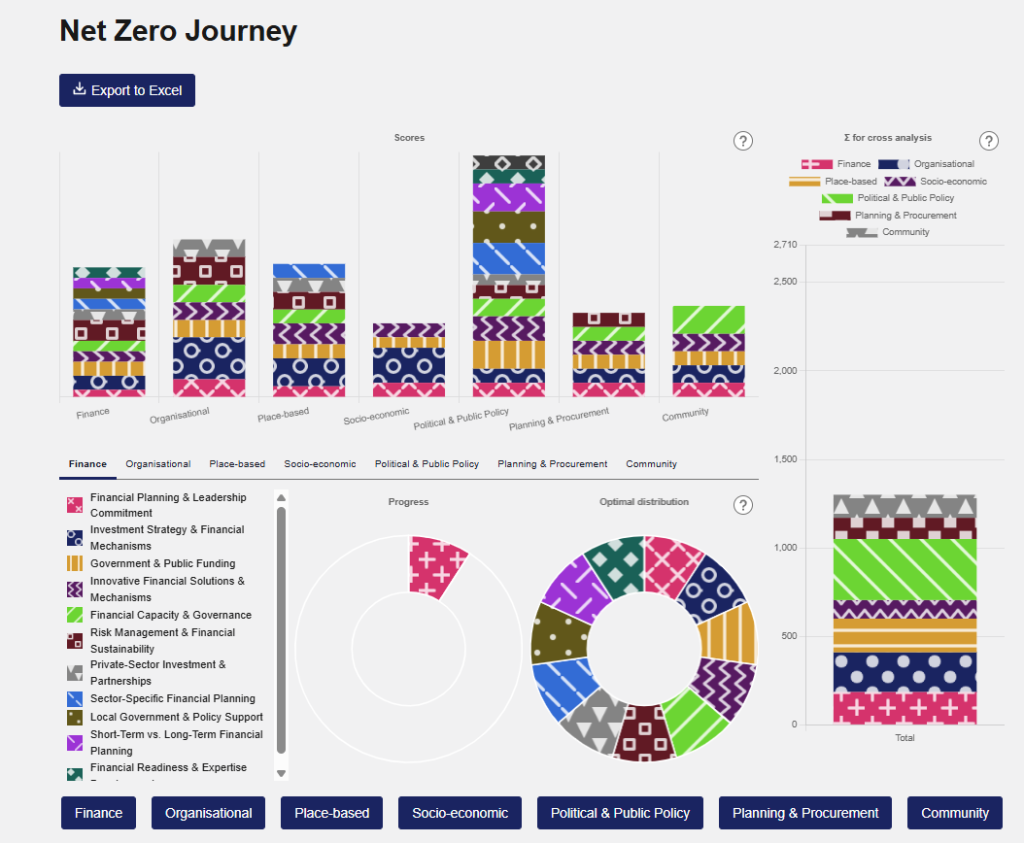
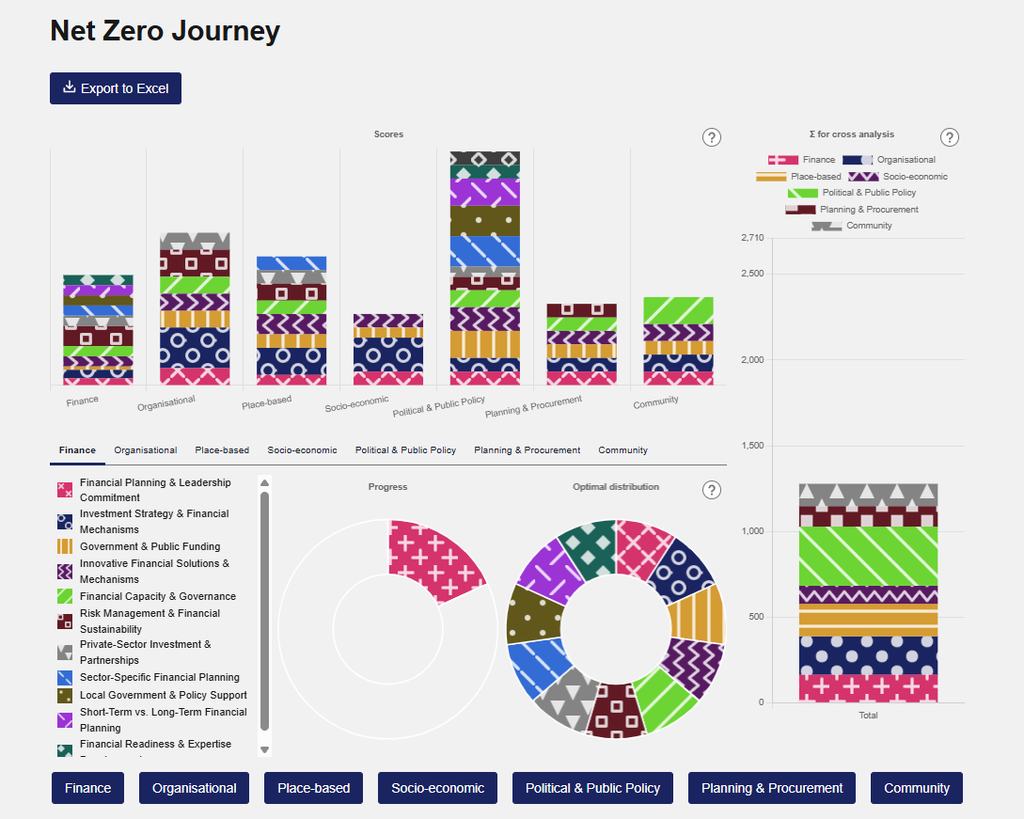
Users respond to a series of statements themed within each of the seven pillars, which assess their organisation’s current approach to Net Zero. The tool converts their qualitative and quantitative responses to benchmark their current conditions. The most useful results are achieved when responses reflect current conditions and evidence rather than future ambitions. The tool then compares current activity against the level needed to support successful Net Zero delivery, generating live graphical scores across each thematic pillar and overall performance.
Results remain available through the website, allowing users to review previous assessments, manage different versions, and export inputs and outputs. Local Net Zero Hub officers can provide support throughout the process, while the tool also signposts relevant guidance and resources. Together, these outputs can help authorities identify priorities, address gaps, and develop a more strategic approach to Net Zero investment and delivery.
The seven pillars
Access to finance
This pillar focuses on the development and diversification of funding sources for Net Zero projects.
It highlights the transition from reliance on government grants and partner funding to accessing larger scale external capital. It addresses the challenges faced in raising capital for non-traditional asset classes and the importance of valuing non-financial benefits to attract investment.
The need for tools that enable intelligent decision-making by local authorities is also emphasised, to enhance their capability to reach investment viability.
Access to finance
1. Financial planning and leadership commitment
The leadership actively includes Net Zero goals in financial planning (e.g., medium-term and annual budgets, and realistic measurements)
Leadership has set specific, measurable financial targets for Net Zero initiatives
The financial targets for Net Zero are aligned with overall business and financial goals (e.g., linked to profitability or operational efficiency)
There are no external pressures or competing priorities that prevent leadership from setting financial targets for Net Zero
The barrier to integrating Net Zero goals in financial planning is not due to a lack of leadership understanding of its long-term financial benefits
2. Investment strategy and financial mechanisms
Does the organisation have a formal investment strategy to finance Net Zero initiatives?
The investment strategy includes a mix of short-term and long-term financing mechanisms (e.g., immediate capital and future revenue models)
The organisation’s investment strategy includes leveraging public and private financing mechanisms (e.g., blended finance, PPPs)
The organisation has considered innovative financing models (e.g., impact investment funds, green bonds, energy-as-a-service)
The organisation has resources, expertise, and confidence in Net Zero returns, even without a formal investment strategy
3. Government and public funding
The organisation has accessed government grants or public funding (e.g., Net Zero Fund, LEVI, and Warm Homes Schemes)
The organisation has deployed grants effectively for feasibility studies or project development
The organisation does not rely on government funding as a primary source for Net Zero initiatives
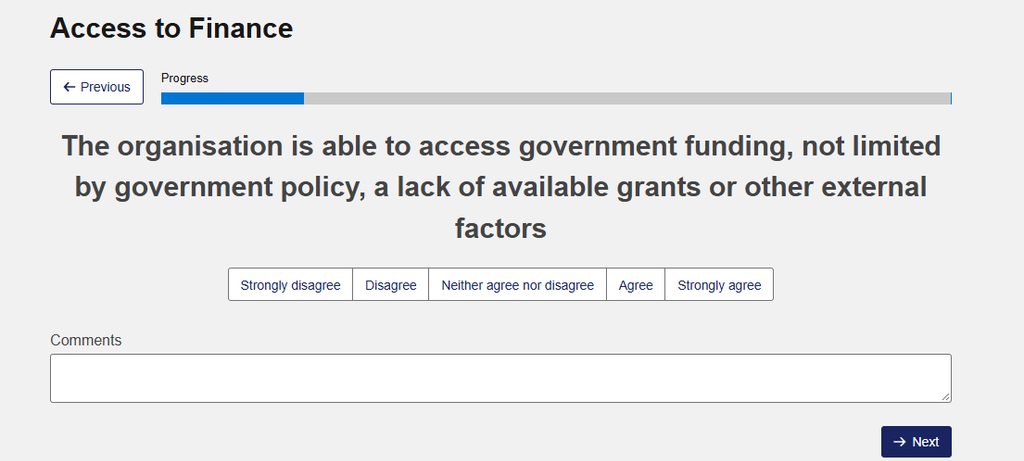
The organisation is able to access government funding, not limited by government policy, a lack of available grants or other external factors.
4. Innovative financial solutions and mechanisms
The organisation has a track record of innovative financial solutions
5. Financial capacity and governance
The organisation has the internal capacity and expertise to manage and deploy Net Zero financial resources effectively
The finance department is actively involved in the governance of Net Zero initiatives
There are governance structures in place to oversee the financial performance and sustainability of Net Zero projects
6. Risk management and financial sustainability
The organisation has identified the level of development funding required to work up capital projects for Net Zero delivery
The organisation has identified commercial and third-party risks associated with Net Zero initiatives (e.g., return on investment, technological risks)
The organisation has a risk management framework to mitigate financial risks (e.g., risk-sharing mechanisms, insurance)
Net Zero projects are financially sustainable in the long term (i.e., do they generate sufficient revenue or savings to cover costs)
7. Private-sector investment and partnerships
The organisation has partnerships with private-sector investors to co-finance Net Zero projects
Public-private partnerships (PPPs) being actively pursued as part of the investment strategy
Track record of innovative/financial mechanisms
8. Sector-specific financial planning
The organisation has sector-specific cost projections for key areas like energy generation, transport, or infrastructure
There are long-term revenue streams identified for Net Zero initiatives (e.g., renewable energy, electric vehicle infrastructure)
Financial models are regularly updated to reflect changes in market conditions, policy, or technology
9. Local government and policy support
The organisation has benefited from financial support or policy frameworks provided by local government or devolution deals
There are local government policies or devolution agreements that align with the organisation’s Net Zero financial goals
10. Short-term versus long-term financial planning
The organisation balances short-term capital needs with long-term financial goals for Net Zero initiatives
There are sufficient financial reserves or contingency plans in place for long-term Net Zero projects
11. Financial readiness and expertise development
The organisation has conducted internal or external audits to assess financial readiness for Net Zero projects
Finance teams have been trained on Net Zero finance or relevant financial certifications (e.g., CIPR)
The organisation is actively improving financial expertise in areas like green finance or sustainability investment
Organisational capacity
This area deals with the organisational capacity and structure necessary for the successful implementation of Net Zero projects.
It compares the expertise and capabilities of different bodies, some with long-standing structures and others rapidly building new ones.
Challenges such as recruitment difficulties and skills shortages are identified, along with the introduction of financial support services to enhance local capacity and facilitate access to external expertise.
Organisational capacity
1. Leadership and strategic commitment
There is effective leadership and strong commitment at the senior management level towards achieving Net Zero goals
There is longevity in the positions which can accelerate Net Zero goals
There are specific programmes led by leadership that have directly contributed to achieving Net Zero
Training, professional development, remuneration or high attention rates among C-level executives are available to improve leadership challenge
Leadership is not hindered by resource limitations, lack of expertise, or competing priorities from senior management. Sufficient time and attention from senior management is dedicated to the Net Zero agenda
There is a framework for balancing competing organisational priorities with the Net Zero agenda
Additional resources and advisory support are available to improve leadership’s focus on Net Zero
2. Staffing and resource capacity
There is a stable staffing (vacancy rates) structure in place to manage long-term Net Zero projects
The organisation has measures in place to retain critical staff
Recruitment strategies are in place to fill key management roles for Net Zero initiatives
Introducing additional incentives, such as higher pay or benefits, could be available to improve retention of senior staff
Staffing shortages are not affecting the implementation of Net Zero projects
This shortage cannot be a long-term problem during expansion of projects
There are relevant measures like hiring consultants being considered
3. Risk appetite and organisational culture
The organisation has a strong risk-appetite for Net Zero projects
There is an entrepreneurial culture fostered within the organisation
There are specific measures in places to mitigate these risks
The organisation is satisfied with the work culture and it drives them to their sustainability goals
The risk averse approach does not impact or delay the delivery of Net Zero goals
The organisation is satisfied with the work culture and does it drive them to their sustainability goals
The entrepreneurial culture, if introduced can speed up the Net Zero targets
4. Decision-making and organisational efficiency
There is a clear decision-making process that aligns with the organisation’s Net Zero goals
The decision-making process is efficient and timely, allowing quick responses to Net Zero challenges
Decision-making processes are regularly reviewed for efficiency and alignment with goals
Improving communication between departments could speed up decision-making
Barriers to effective decision-making are related to unclear roles (disagree) or departmental silos (agree)
Creating cross-departmental task forces could improve collaboration
Clearer role definitions could help improve decision-making
5. Internal skills and consultant dependency
The organisation only utilises consultants where there is a specific project or portfolio requirement. It is not a routine option to build a business case
There is a structured plan to transfer knowledge (embedding knowledge) from consultants to internal staff
Knowledge transfer processes are effectively building long-term internal capacity
There is a structured handover process in place to further enhance internal capacity.
The organisation has sufficient internal expertise to manage Net Zero initiatives without external consultants
Internal teams benefit from further training which reduces reliance on consultants
The organisation has the capability to overcome expertise gaps in managing Net Zero initiatives and drive progress
6. Stakeholder and business partnerships
The organisation has strong partnerships with stakeholders to achieve Net Zero goals
The organisation has strong partnerships with local businesses to achieve Net Zero goals
There are opportunities to expand partnerships to more local businesses
There is a plan in place to expand these partnerships in the near term
There is an alternative plan in place to facilitate the Net Zero goals
There are no significant challenges hindering the development of stronger partnerships with local organisations
There is capacity to foster better alignment of goals with local stakeholders and strengthen partnerships
There are plans to seek additional funding or support to improve partnerships
7. Inter-district collaboration and resource sharing
Your organisation collaborates effectively with other districts on Net Zero projects
There are opportunities to further enhance collaboration with other districts
Formalising inter-district partnerships (e.g., through agreements or joint initiatives) could further improve collaboration
There are no challenges that are affecting collaboration between districts
Resource limitations are not preventing effective collaboration with other districts
Policy differences between districts do not affect collaboration
Pooling resources between districts could improve collaboration on shared goals
8. Staffing and resource capacity
The organisation has the resources to introduce new Net Zero posts where a gap is identified
What is the current vacancy rate in terms of percentage in your organisation?
Place-based
This pillar underscores the importance of adapting Net Zero strategies to the unique socio-economic and geographic characteristics of an area.
It discusses how local conditions, such as economic disparities and energy needs, dictate the adoption of specific technologies and approaches.
The focus is on creating tailored solutions that address local challenges and opportunities, whether in urban or rural settings.
Place-based
1. Land and asset availability for renewable energy
Are you predominantly urban or rural as a local authority area?
Public assets (e.g., buildings, lands) are available for renewable energy projects
These urban assets are being fully utilised for renewable energy projects (e.g. solar, EV chargers)
There is no pace constraint (e.g. limited land) that might affect your ability to deploy more renewable energy technologies
There is land available for large-scale renewable energy projects (e.g., solar, wind farms)
Competing land uses, such as agriculture, do not prevent renewable energy projects from going ahead
The land can be used for both renewable energy projects and other purposes like agriculture at the same time
There is both capacity and commitment to utilise land fully for renewable energy projects
2. Funding and investment for Net Zero projects
The organisation has sufficient funding to deliver your Net Zero projects
The organisation’s funding sources are diversified (e.g., public, private, grants)
Private investment is a significant part of your funding structure
Investor interest in your projects is strong enough to secure the necessary funding
Funding availability is not affected by the small size of available projects
It is recognised that bundling smaller projects together could help secure more funding
There are no barriers preventing access to public funding sources (e.g., lack of eligibility, bureaucracy)
It is recognised that external advisory support would help navigate public funding opportunities
3. Optimal use of organisational resources
The organisation’s resources (land, buildings, infrastructure) are optimally used for renewable energy and energy efficiency improvements
The organisation has unused assets (e.g., rooftops, car parks) that could be developed for renewable energy projects
Lack of data or energy assessments are not a reason of preventing optimal resource use
4. Coordination between housing and climate teams
There is existing coordination between housing teams and climate/Net Zero teams
It is understood how external data support (e.g., energy audits) would help optimise your resource use
Despite challenges in management and coordination, measures are in place to support the effective use of resources
It is understood how improved coordination or resource management systems could help optimise the use of available assets
5. Grid capacity and energy infrastructure
Adequate grid capacity and energy infrastructure are enabling the deployment of renewable energy technologies
Decentralised energy (e.g., local grids, energy storage) is being considered to address grid limitations
There are pilot projects or early-stage systems exploring decentralised energy solutions
Renewable energy technologies (e.g., solar, wind, EV charging) are being deployed at scale across your region
6. Local Area Energy Plan (LAEP) and energy planning
The organisation has a Local Area Energy Plan (LAEP) to guide energy infrastructure and planning
The LAEP is supporting effective collaboration and the scaling of Net Zero projects
The organisation understand how the LAEP could be adjusted to better support collaboration or project scaling
Funding is sufficient to support the development of a Local Area Energy Plan (LAEP)
Coordination with stakeholders is effective and not a barrier to developing a Local Area Energy Plan (LAEP)
7. Partnerships for Net Zero projects
Partnerships are in place with local businesses, energy providers, or other local authorities for Net Zero projects
These partnerships are effectively pooling resources and knowledge to accelerate progress
Trust and aligned priorities are enabling effective partnerships
8. Innovative technologies and deployment
Innovative technologies (e.g., decentralised energy, energy storage, smart grids) are being deployed in your region
These technologies are being deployed at scale or only in pilot projects
Cost and infrastructure are not significant barriers to technology deployment
Socio-economic
Focusing on the intersection of Net Zero goals with local economic and social outcomes, this pillar examines the impact of skills development and supply chain readiness on the deliverability of Net Zero portfolios.
It highlights the need for community-level Net Zero skills and initiatives and discusses how embedding socio-economic benefits can foster local support and enhance the overall success of these projects.
Socio-economic
1. Job creation and economic growth
The organisation’s Net Zero initiatives are contributing to local job creation and economic growth
Jobs are created by these initiatives primarily in sustainable industries (e.g., renewable energy, green technology)
Job opportunities are accessible to residents from lower-income areas
There is sufficient investment in Net Zero sectors to drive job creation
2. Smart technology accessibility and adoption
Smart technologies (e.g., heat pumps, solar panels) are accessible to all residents in your region
There is a high adoption rate of smart technologies across all income groups
The financial burden of adopting smart technologies is not a barrier for residents in lower-income areas
Consumers trust the technology and do not perceive it as overly complex, reducing resistance
There is public education or outreach programme in place to address mistrust and educate residents on the benefits of these technologies
There is financial support available to help residents with the costs of adopting these technologies
3. Fuel poverty and air quality
Fuel poverty reduction is an essential part of your Net Zero strategy
Fuel poverty rates have been reduced as a result of your Net Zero initiatives
There is a noticeable improvement in air quality due to your Net Zero initiatives
There is infrastructure in place for clean energy solutions (e.g., EV charging) to improve air quality
The cost of renewable energy technologies for low-income households does not hinder efforts to reduce fuel poverty
4. Social inclusion and just transition
The region is addressing social deprivation through Net Zero strategies, as part of the just transition
There are initiatives in place to build community wealth (e.g. local job creation) as part of your Net Zero strategy
These initiatives are inclusive of lower-income areas or socially deprived communities
The high cost of implementing Net Zero initiatives in deprived areas is not a significant barrier
Political and public policy
This area explores the influence of political structures and public policy on the development and delivery of Net Zero.
It discusses how diverse political perspectives within local governance can affect the planning and execution of Net Zero initiatives.
The empowerment derived from devolved governmental powers is also highlighted, stressing the need for a nuanced understanding of local political environments to tailor effective investment strategies.
Political and public policy
1. Political leadership and commitment
The political figurehead for the authority (e.g., the Mayor) has demonstrated leadership by championing Net Zero through tangible policies and public communications
Specific policies, programmes, or public communications have been initiated and publicly shared
There is visible leadership or initiatives to champion Net Zero
2. Adopted strategy and policy stability
There is an adopted strategy for achieving Net Zero
There is strong cross-party consensus within the local authority on achieving Net Zero, ensuring continuity regardless of political changes
Mechanisms, such as formal agreements or joint committees, exist to ensure political stability around Net Zero.
Net Zero commitments have been integrated into the authority’s broader strategic priorities, such as economic development, housing, and transportation plans
Political divisions or shifting priorities have NOT delayed or disrupted Net Zero initiatives
3. Governance and accountability
A clear governance structure is in place to oversee Net Zero policies, with accountability mechanisms to measure progress against defined targets
Regular reporting processes and oversight bodies exist to monitor Net Zero progress
There is commitment to improve governance structures and accountability
Internal and external scrutiny processes are effective in identifying gaps and ensuring Net Zero policies are progressing as planned
4. Funding and financial commitment
Financial frameworks (budgets, funding priorities) reflect the authority’s commitment to Net Zero, including alignment with business interests and operational goals
Devolution of powers and funding has been leveraged to implement local Net Zero initiatives, addressing region-specific challenges and opportunities
Devolved powers have resulted in region-specific Net Zero projects with tangible progress
Devolution has been leveraged effectively, resulting in no missed opportunities for progress
5. Legislative alignment and policy updates
Net Zero policies are reviewed and regularly updated to align to Local Growth Plans, Local Industrial Decarbonisation Plans and Local Area Energy Plans (where present)
The authority regularly reviews and updates Net Zero policies to reflect national legislative changes, emerging technologies, and local progress
Decision-makers have taken visible steps, such as funding projects or advocating for Net Zero
Net Zero policies are NOT outdated or DO NOT lack mechanisms for periodic review
6. Public communication and vision
There is a clearly communicated long-term vision for Net Zero that has been shared with residents and businesses, with evidence of widespread understanding and support
Communication campaigns have led to strong public understanding and support for Net Zero goals
There is a clear communication about the authority’s long-term vision for Net Zero
7. Risk mitigation and resilience
Policies are in place to mitigate risks to Net Zero progress caused by changes in political leadership, economic conditions, or public support
Contingency plans ensure Net Zero progress remains resilient to external risks
8. Regional and corporate integration
The appetite for Net Zero is equal across the region
Net Zero is incorporated into our corporate plan, borough plan, and planning frameworks
Scrutiny mechanisms are in place challenge groups both internal and external
9. Net Zero project implementation
The first Net Zero projects in the pipeline have commenced, with the local authority and/or Mayoral Combined Authority as building blocks for delivery
Drivers alongside Net Zero have been identified to align with Net Zero policy (such as social value)
Net Zero has been included in devolution plans
10. Political stability and decision-maker buy-in
There is stability in the authority – even if the party/policy changes projects can still progress
There is buy-in from key decision-makers such as local authority boards and their respective Investment Boards
11. Political barriers to implementation
The organisation has measures to manage political priority differences that could slow Net Zero policy development and progress
There is a clear political stakeholder engagement process to unify the position and coalesce around common aims and ambitions
12. Local community benefits and national policy alignment
Current policies highlight the benefits of Net Zero for individual local communities, along side the wider goals and community benefits for the whole authority area
Policies have been reviewed and developed as national policy changes
A refresh of Net Zero policy has been considered to show the benefits of Net Zero to individual communities
Planning and procurement
Addressing the operational challenges in implementing Net Zero initiatives, this pillar focuses on the hurdles associated with planning and procurement processes.
It identifies varying levels of success across different areas, influenced by local capacities and regulatory frameworks.
The role of new procurement services in enhancing immediate and long-term capabilities is discussed, along with the strategic use of planning tools to facilitate Net Zero developments.
Planning and procurement
1. Strategic planning
There is a clear and adopted strategy for achieving Net Zero within the organisation (e.g., Routemap to Carbon Negative, LAEPs)
The strategic priorities and actions in the plan aligned with the region’s decarbonisation goals
The main barrier to strategy development is not due to a lack of resources (financial, personnel)
The current strategic plan (e.g., Routemap to Carbon Negative) actively being implemented through key projects and initiatives
2. Project execution and monitoring
The current strategic plan (e.g., Routemap to Carbon Negative) actively being implemented through key projects and initiatives
There is a project management and evaluation framework in place to track progress and outcomes (e.g., workplan trackers, metrics, stakeholder engagement)
The main barrier to implementation is not related to delays in project initiation
The key project outcomes (e.g., energy-efficient buildings, low-carbon mobility, green spaces) are being delivered on schedule
There is sufficient data and clear metrics to establish monitoring
3. Procurement process
The current procurement processes are streamlined and efficient for Net Zero projects
The process for selecting project partners (e.g., suppliers, contractors) is effective in bringing on the right partners for Net Zero delivery
Project teams have adequate resources and capacity (e.g., skilled personnel, financial resources) to meet procurement needs
Complexity and scale of the programmes do not cause delay in procurement
4. Resource and capacity
Project teams have adequate resources and capacity (e.g., skilled personnel, financial resources) to meet procurement needs
There is a strategy in place to strengthen skills and capacity for Net Zero procurement within the internal teams
5. Contract and risk management
There is a commercial review process involving legal, procurement, and finance teams for assessing the procurement approach and contract management
Contract management is being handled effectively to ensure value for money and avoid quality management issues during project delivery
Departmental integration (between (legal, procurement, finance) supports a robust review process between departments
6. Stakeholder collaboration
External procurement teams (e.g., third-party DPS or procurement frameworks) are providing effective support for the organisation’s Net Zero goals
Internal and external procurement teams are effectively collaborating to streamline processes and avoid delays
Strong coordination exists between external procurement and internal project teams
Community engagement
This final pillar emphasises the critical role of community involvement in the success of Net Zero projects.
It advocates for strong, localised participation where community members actively contribute to project shaping.
Techniques for building trust and securing long-term community support are discussed, highlighting the importance of inclusivity and responsiveness to local needs in achieving sustainable Net Zero transitions.
Community engagement
1. Net Zero plan accessibility
You have made your Net Zero routemaps (LAEP, local policies, etc.) accessible for communities to engage with
A community can see plans at a local (e.g., village or neighbourhood) level, through an interactive map or similar tool
Feedback has been gained from community groups and incorporated into the Net Zero plans
There are no specific barriers preventing the community’s feedback from being incorporated (e.g., lack of engagement, lack of capacity to process feedback)
There no significant barriers to making Net Zero information available in a community-friendly, accessible format (e.g., capacity and resources)
2. Community engagement and events
Community events (e.g., roadshows or awareness activities) have taken place at the localised level throughout the authority area
The responses were positive and the level of engagement was as expected
There was representation from across different types of communities (e.g., urban deprived, rural, farming communities, business community and community groups)
Engagement events have taken place in specific areas (either geographical or by theme)
There are no barriers to engaging with certain groups (e.g., hard to reach, cost, local objections, or misinformation)
3. Community leadership and trust
Community champions are in place to help convey the benefits of Net Zero and combat misinformation
The community champions are effective in engaging the community and addressing misinformation
There is a strong community involvement at multiple levels, with residents shaping projects and trust established
Trust and respect is established between community and local authority
There are no barriers (e.g., cost, misinformation, local objections) preventing engagement in certain communities
4. Demonstrator projects and participation
There are publicly accessible demonstrator projects in place to promote the benefits of Net Zero and showcase appropriate technological solutions
The levels of uptake and participation in the demonstrator projects are positive
If uptake is low, the resources for improved marketing can be provided
There are sufficient resources and identified sites to support the implementation of demonstrator projects
5. Community energy sector growth
We are able to use local organisations, e.g., NGOs to carry the Net Zero message
The community energy sector is active across the area
Successful projects have been delivered and are they able to act as exemplars for others
There are projects in the pipeline which are not facing any barriers that are preventing them from coming to fruition
Support is in place to enable community energy groups to thrive
Uptake in community energy groups is fueled by horizontal collaboration, not just external support
There is no support needed to identify the non-technical barriers preventing community energy groups to grow
Before you start
See the questions first
You can review the full question list before starting. This helps you involve the right people and understand the context. Return to the to complete the questionnaire in the Diagnostic Tool and receive your scores.
The tool is designed to bring finance, leadership, planning, environment, neighbourhoods, and democratic services teams together around a shared objective. Some questions may need input from elected members.
Time commitment
The initial assessment takes 2–3 hours. It’s designed to give a clear picture of where investment and capacity-building are needed – not just to show gaps, but to guide next steps.
How it works
Step 1: Complete the assessment
Answer a dedicated set of questions across the seven pillars.
Step 2: Review your results
Get instant visual feedback showing where your organisation is strong and where there is room for growth.
Step 3: Explore targeted support
Enter your investment journey to access resources that help you upskill and build capability.
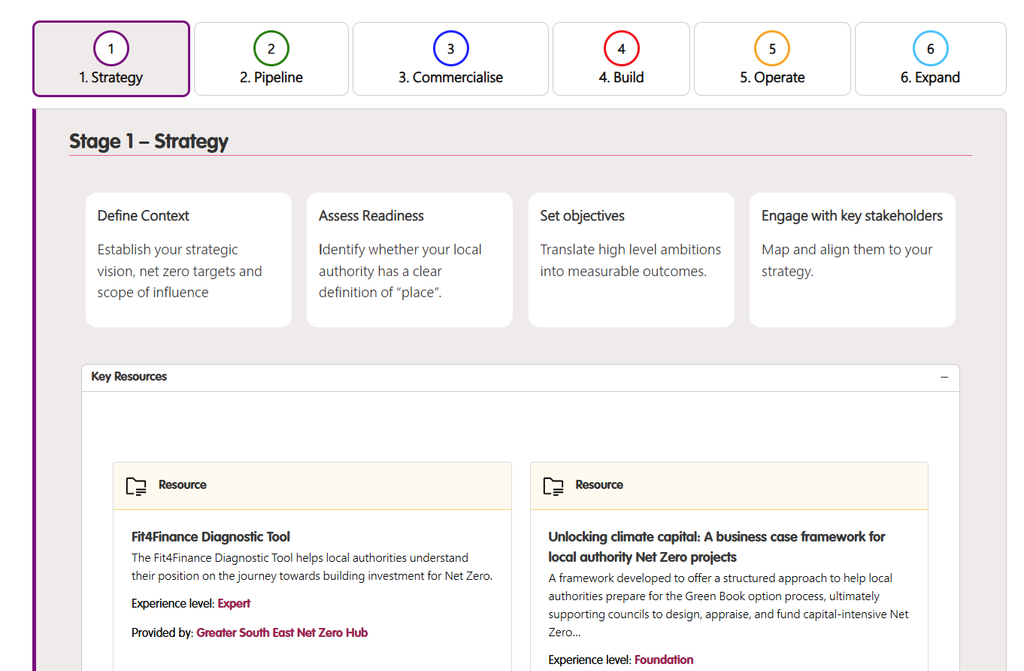
Wondering how to find the most relevant tools for each stage?
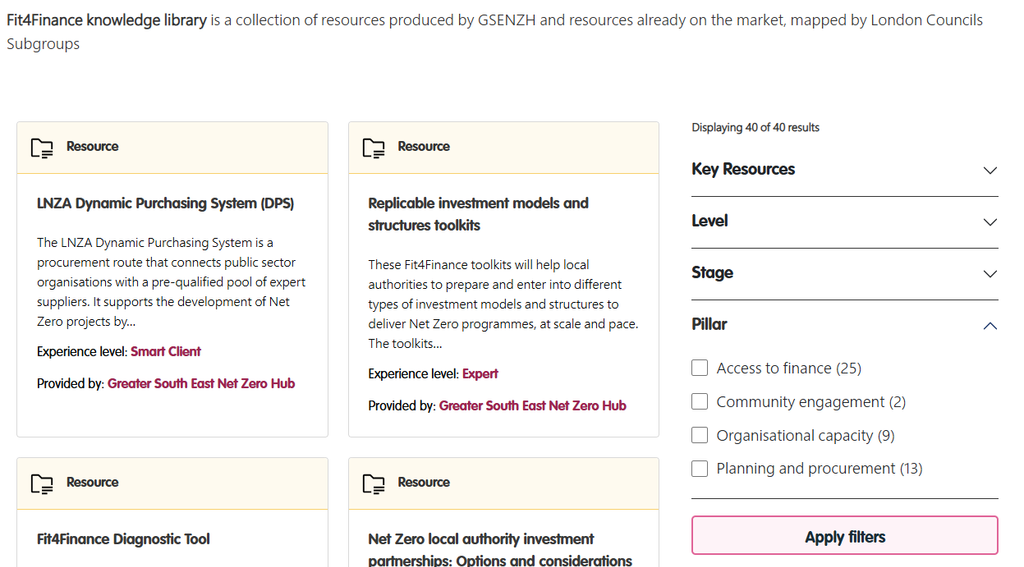
Use your Diagnostic Tool results, every resource in the Fit4Finance knowledge library is tagged to the seven pillars it supports most. These materials provide targeted guidance to close knowledge and organisational gaps, strengthen your capacity, and improve your readiness to attract blended finance.
You can export results from the Diagnostic Tool and revisit the tool anytime for updates.
Fit4Finance resources are designed to help local authorities move from isolated, grant-funded projects to scalable, investment-ready portfolios.
They include diagnostic tools, case studies, training, and investment models to support project delivery, unlock blended finance, and encourage collaboration across finance, climate, housing, and economic development teams.
Guest preview of selected publicly available resources
Full library of 1,000+ articles
CPD accredited e-learning courses
Case studies
Discussion forum
Manage Consent
To provide the best experiences, we use technologies like cookies to store and/or access device information. Consenting to these technologies will allow us to process data such as browsing behaviour or unique IDs on this site. Not consenting or withdrawing consent, may adversely affect certain features and functions.
Functional
Always active
The technical storage or access is strictly necessary for the legitimate purpose of enabling the use of a specific service explicitly requested by the subscriber or user, or for the sole purpose of carrying out the transmission of a communication over an electronic communications network.
Preferences
The technical storage or access is necessary for the legitimate purpose of storing preferences that are not requested by the subscriber or user.
Statistics
The technical storage or access that is used exclusively for statistical purposes.The technical storage or access that is used exclusively for anonymous statistical purposes. Without a subpoena, voluntary compliance on the part of your Internet Service Provider, or additional records from a third party, information stored or retrieved for this purpose alone cannot usually be used to identify you.
Marketing
The technical storage or access is required to create user profiles to send advertising, or to track the user on a website or across several websites for similar marketing purposes.




 Guest preview of selected publicly available resources