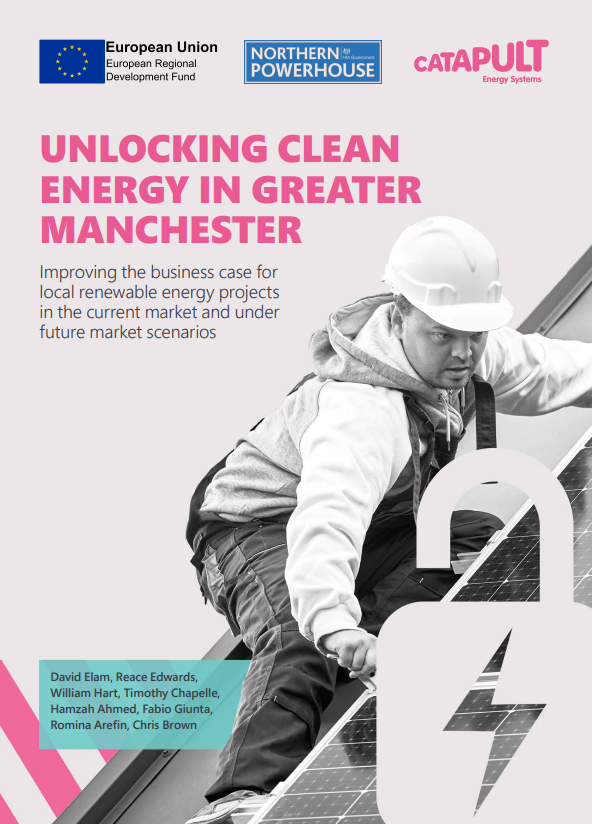
Improving the business case for local renewable energy projects in the current market and under future market scenarios.
Resource
Improving the business case for local renewable energy projects in the current market and under future market scenarios.


Greater Manchester Combined Authority declared a climate emergency in 2019 and launched its Five-Year Environment Plan, which sets out a long-term environmental vision to be carbon neutral by 2038 and the urgent actions that need to be taken in the next five years to help achieve this. The Unlocking Clean Energy in Greater Manchester (UCEGM) project was conceived as part of this vision. UCEGM is a European Regional Development Fund (ERDF) funded project comprised of two workstreams:
 The selected WS1 local renewable generation projects included the following archetypes: roof-mounted solar photovoltaic (PV), ground-mounted solar PV, and solar PV carports. The projects were located within Greater Manchester and the installed capacity (size) of the projects tended to be less than 5MWp in rural locations, and typically less than 0.5MWp in urban. The projects focused solely on developing new local electricity generation assets and did not include the acquisition by local authorities of existing assets, development of standalone battery or energy storage, or low-carbon heating infrastructure, all of which are important to the delivery of local Net Zero energy systems.
Smaller-scale, local generation projects (as per the selected WS1 sites) have historically been seen as problematic from a financial viability perspective, due to lacking economies of scale and the removal of feed-in tariffs. Hence, they have typically relied upon grant funding. Reliance on grant funding to develop and initiate renewable generation assets can cause additional complexity for local authorities, such as grant funding timescales not aligning with project planning and delivery timescales, or grant funding obligations and requirements not reflecting local circumstances or decarbonisation priorities.
To truly unlock the value of local renewable generation, there needs to be ways of developing smaller-scale projects other than grant funding (noting that their small size (less than 5MWp) typically precludes contracts for difference (CfD)). Investing in energy assets with a lifespan of over 20 years means that their viability is subject to changes in future energy prices, markets, and policies. This report considers the potential risks and opportunities for such projects and how to address them. The first phase of WS2 demonstrated how innovative business models, good practice procurement methods, and alternative routes to finance can improve the business case for these types of renewable generation projects, reducing the need for grant funding. The outputs, whilst using Greater Manchester local authorities as a pilot, are usable by all local authorities and include steps that will improve business cases.
In the second phase of WS2, the impact that different electricity market scenario designs could have on the costs and revenues of six sample projects was dynamically modelled. Market scenarios focused on the main policy choices currently being explored under the Government’s Review of Electricity Market Arrangements (REMA) – the status quo of uniform national pricing, introduction of location-specific pricing (locational marginal pricing, LMP), and separate pricing arrangements for renewable and non-renewable electricity (split markets). The results of the modelling were used to make a qualitative assessment of the impact on potential business models that local authorities may adopt.
The Catapult also considered qualitatively the potential for local electricity markets and advanced network management by Distribution Network Operators (DNOs) to provide additional sources of revenue for local energy projects.
It should be noted that the current energy crisis emerged during this project and the project has attempted to balance addressing the immediate priorities with solutions that will perform once the current market volatility has reduced.
ESC is making this report available under the following conditions. This is intended to make the Information contained in this report available on a similar basis as under the Open Government Licence, but it is not Crown Copyright: it is owned by ESC. Under such licence, ESC is able to make the Information available under the terms of this licence. You are encouraged to Use and re-Use the Information that is available under this ESC licence freely and flexibly, with only a few conditions. Using information under this ESC licence Use by You of the Information indicates your acceptance of the terms and conditions below. ESC grants You a licence to Use the Information subject to the conditions below. You are free to:
You must, where You do any of the above:
These are important conditions of this licence and if You fail to comply with them the rights granted to You under this licence, or any similar licence granted by ESC, will end automatically.
Designed to aid Local Authorities in developing robust, evidence-based plans to enable Net Zero.
Already have an account? Login
 Guest preview of selected publicly available resourcesFull library of 1,000+ articlesCPD accredited e-learning coursesCase studiesDiscussion forum