
Group purchasing is an approach where numerous customers come together to buy products and/or services at scale to achieve cost reductions.
Resource
Group purchasing is an approach where numerous customers come together to buy products and/or services at scale to achieve cost reductions.
Experience Level:
Smart Client
Provided by: Energy Systems Catapult


This approach has been particularly effective for solar PV technology, with average savings of 10-25% compared to typical market prices been observed in recent years.
A similar model could help partially address high upfront costs associated with heat pump technologies.
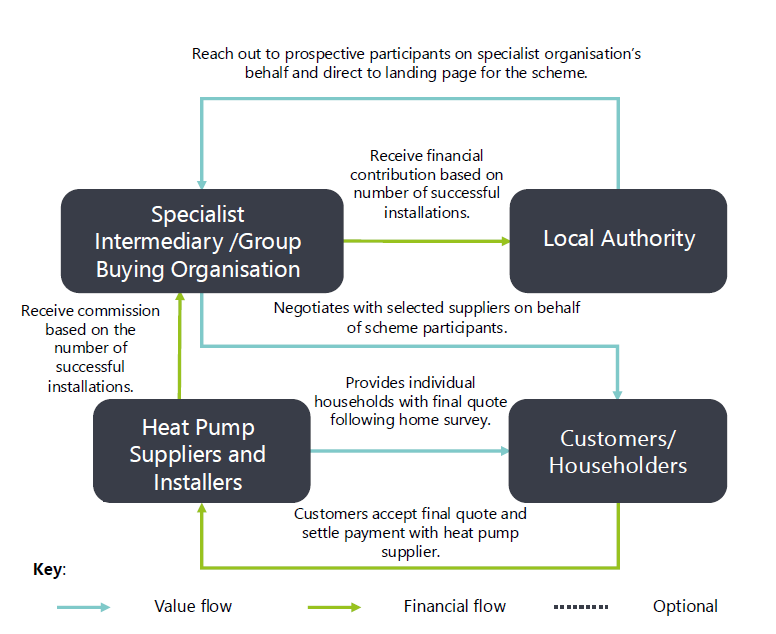
Local authorities could partner with a specialist group buying organisation to enact a group buying scheme forheat pumps in the area. They could promote the scheme through their website and social media platforms to encourage registration among households.
The specialist organisation would be responsible for negotiating the best price with heat pump suppliers and installers on behalf of participants.
Local authorities may receive some financial contributions from the specialist organisation depending on the number of successful installations, which could be used to fund other decarbonisation initiatives.
The Energiesprong Global Alliance, in collaboration with European partners, has launched the Street HP Reno project, aiming to reduce the cost of heat pumps for private individuals through collective purchasing. Energiesprong will collaborate with municipalities to find homeowners who are interested in collectively switching to heat pumps.
As the facilitator of the scheme, Energiesprong will also work with heat pump suppliers to develop a product that is easer to purchase for customers. Training will also be provided to heat pump suppliers and installers.
The project ran from October 2023 until October 2026.
The total budget for the project is €2,250,734, with €2,138,198 of this amount awarded by the European Commission.
The first collective heat pump purchase is expected to take place in France. If successful, the approach will be rolled out to other participating European countries, including the Netherlands, Belgium, Germany and Italy.
Nesta aimed to explore whether group buying could be effective for heat pumps in the UK, following its success in solar PV deployment.
The study executed the following method:
The total budget for the project is €2,250,734, with €2,138,198 of this amount awarded by the European Commission.
ESC is making this report available under the following conditions. This is intended to make the Information contained in this report available on a similar basis as under the Open Government Licence, but it is not Crown Copyright: it is owned by ESC. Under such licence, ESC is able to make the Information available under the terms of this licence. You are encouraged to Use and re-Use the Information that is available under this ESC licence freely and flexibly, with only a few conditions. Using information under this ESC licence Use by You of the Information indicates your acceptance of the terms and conditions below. ESC grants You a licence to Use the Information subject to the conditions below. You are free to:
You must, where You do any of the above:
These are important conditions of this licence and if You fail to comply with them the rights granted to You under this licence, or any similar licence granted by ESC, will end automatically.
Designed to aid Local Authorities in developing robust, evidence-based plans to enable Net Zero.
Already have an account? Login
 Guest preview of selected publicly available resourcesFull library of 1,000+ articlesCPD accredited e-learning coursesCase studiesDiscussion forum