
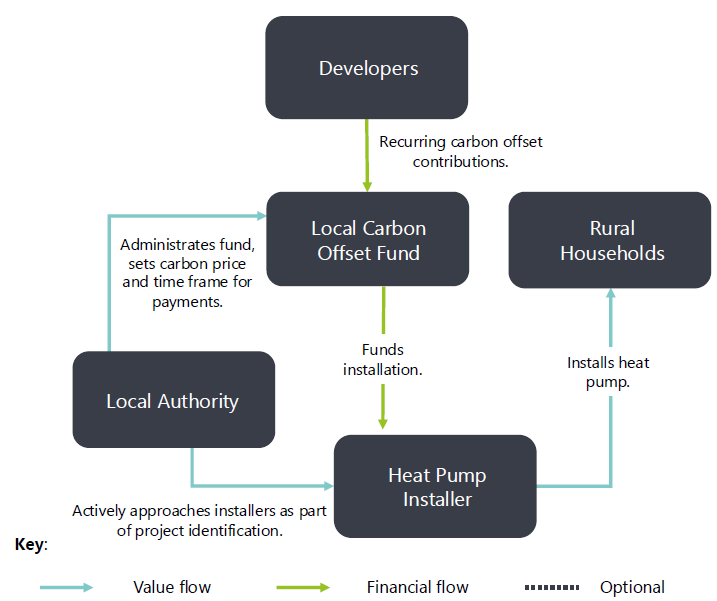
Local carbon offset funds are set up by local authorities to collect and distribute carbon offset payments made by developers as part of their Section 106 agreements.
Resource
Local carbon offset funds are set up by local authorities to collect and distribute carbon offset payments made by developers as part of their Section 106 agreements.
Experience Level:
Smart Client
Provided by: Energy Systems Catapult


A section 106 agreement is a legally binding agreement or ‘planning obligation’ between a local planning authority and a property owner. It mitigates the impact of a development on the local community, setting out terms binding the developers to provide, facilitate, or fund measures needed for the development to be acceptable in planning terms.
In 2016, the GLA introduced carbon offsetting for all major domestic developments through the London Plan, requiring local authorities to establish local carbon offset funds. Other councils followed suit.
In this model, local authorities would set carbon emissions exceeding Part L of the Building Regulations (e.g., a 35% on-site reduction). Developers falling short of the target would contribute to the local authority’s offset fund. Contributions are based on a set carbon price, with recurring payments made over a set period. In the case of smaller developments, the developer pays a flat fee per unit.
This would require the local authority to set a carbon price and a time frame for payments. An example contribution formula would be:
Carbon offset contribution = Carbon gap (residual tonnes) x Price of carbon (£) x Numbers of yearsAlongside administering the fund collection and allocation, the local authority would also need to identify a suitable range of projects to be funded through the carbon offset fund, which would feature heat pump installations.
Milton Keynes City Council own and operate a Carbon Offset Fund to support carbon reduction projects.
Set up in 2005, it was the first city in the UK to set up a Carbon Offset Fund, setting an example for other local authorities to follow suit thereafter.
Eligible projects include heat pump installations, insulation upgrades and solar panel installations. The fund provides up to 50% match funding to support projects. It is aimed at community groups and public organisations, such as schools, not-for-profit groups and parish councils.
Developers are required to pay £200 per tonne of annual CO2 emissions into the fund.
The fund has collected £6.3 million since its inception. It has also received 55 enquires since 2022 until 2024, seeking £2.9 million in contributions.
The fund has awarded £470,000, resulting in 12 completed projects (as of August 2024).
ESC is making this report available under the following conditions. This is intended to make the Information contained in this report available on a similar basis as under the Open Government Licence, but it is not Crown Copyright: it is owned by ESC. Under such licence, ESC is able to make the Information available under the terms of this licence. You are encouraged to Use and re-Use the Information that is available under this ESC licence freely and flexibly, with only a few conditions. Using information under this ESC licence Use by You of the Information indicates your acceptance of the terms and conditions below. ESC grants You a licence to Use the Information subject to the conditions below. You are free to:
You must, where You do any of the above:
These are important conditions of this licence and if You fail to comply with them the rights granted to You under this licence, or any similar licence granted by ESC, will end automatically.
Designed to aid Local Authorities in developing robust, evidence-based plans to enable Net Zero.
Already have an account? Login
 Guest preview of selected publicly available resourcesFull library of 1,000+ articlesCPD accredited e-learning coursesCase studiesDiscussion forum