
Carbon credit monetisation provides an additional funding stream for social housing retrofit via the Retrofit Credits scheme, developed by HACT with PNZ Carbon.
Resource
Carbon credit monetisation provides an additional funding stream for social housing retrofit via the Retrofit Credits scheme, developed by HACT with PNZ Carbon.
Experience Level:
Smart Client
Provided by: Energy Systems Catapult


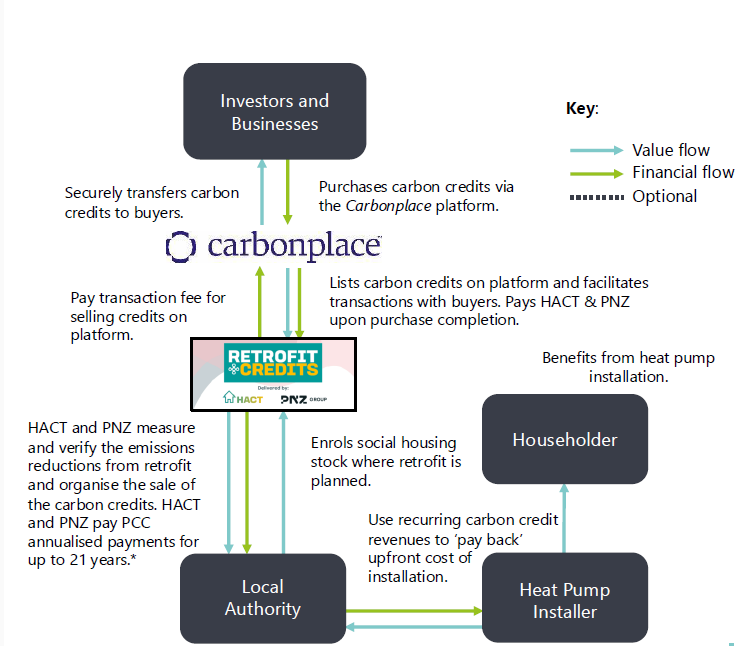
Emissions reductions from retrofit works are verified and converted into carbon credits, which are then sold to organisations seeking to offset their emissions, such as Berkeley Group, Unity Trust Bank and the Economist Group. The resulting revenue is paid back to the local authority or housing association and can be recycled into further retrofit projects.
Local authorities can enrol social housing stock for planned retrofit, with projected credits calculated in advance to support the investment case. HACT manages verification and credit sales, and payments reflect both carbon savings and wider social value.
The model works best for whole house retrofit, rather than standalone heat pump installations, to maximise credit revenue and ensure the heat pump operates effectively alongside insulation upgrades.
However, credits are issued and sold annually after works are complete, with revenues spread over roughly 21 years, so this does not provide substantial upfront capital for installation costs.
Camden Council piloted HACT & PNZ Carbon’s Retrofit Credits scheme with their completed social housing projects in 2023. Their involvement was supported by the Mayor of London’s Future Neighbourhood programme. It was one of 22 social housing providers to have benefitted from the pilot.
Following the success of the pilot. Camden Council partnered with the initiative to launch the Camden Retrofit Credits scheme.
Camden initially secured £3 million from the Greater London Authority (GLA) Future Neighbourhood programme to develop a local carbon offset fund to part-finance the retrofits.
Over a 19-year life span from 2024, the revenues from carbon credits could meet around 10% of the CAPEX costs for retrofit in Camden.
Camden Council are also discussing a separate pilot for 3000 homes, which could generate approximately £4.7 million over 17 years.
The initial pilot involved 53 completed social housing retrofit projects in 2023. Data pertaining to subsequent retrofit projects that generated carbon credits was not publicly available.
Luton Council have been engaged with the Retrofit Credits scheme since 2022, building on its existing efforts to improve the energy efficiency of its housing stock.
Rather than fully funding projects, the scheme provided supplementary funding for ongoing work. This is driven by the revenue model of the scheme, where credits are sold annually after project completion. Consequently, it does not provide a significant upfront capital contribution to the cost of installation.
Luton Council have onboarded nearly 997 homes as of the end of 2023. These 997 projects have achieved over 900 tCO2e reduction and an estimated £600,000 worth of social value since 2022.
Social value refers to the positive social outcomes for residents, such as improved health, comfort, and reduced fuel poverty.
ESC is making this report available under the following conditions. This is intended to make the Information contained in this report available on a similar basis as under the Open Government Licence, but it is not Crown Copyright: it is owned by ESC. Under such licence, ESC is able to make the Information available under the terms of this licence. You are encouraged to Use and re-Use the Information that is available under this ESC licence freely and flexibly, with only a few conditions. Using information under this ESC licence Use by You of the Information indicates your acceptance of the terms and conditions below. ESC grants You a licence to Use the Information subject to the conditions below. You are free to:
You must, where You do any of the above:
These are important conditions of this licence and if You fail to comply with them the rights granted to You under this licence, or any similar licence granted by ESC, will end automatically.
Designed to aid Local Authorities in developing robust, evidence-based plans to enable Net Zero.
Already have an account? Login
 Guest preview of selected publicly available resourcesFull library of 1,000+ articlesCPD accredited e-learning coursesCase studiesDiscussion forum