The Mind the Gap insight, developed under Innovate UK’s Net Zero Living Programme in partnership with Regen, examines how to support those homes that fall between individual heat pumps and large-scale heat networks.
Resource
The Mind the Gap insight, developed under Innovate UK’s Net Zero Living Programme in partnership with Regen, examines how to support those homes that fall between individual heat pumps and large-scale heat networks.
Experience Level:
IntermediatePart of: Net Zero Living


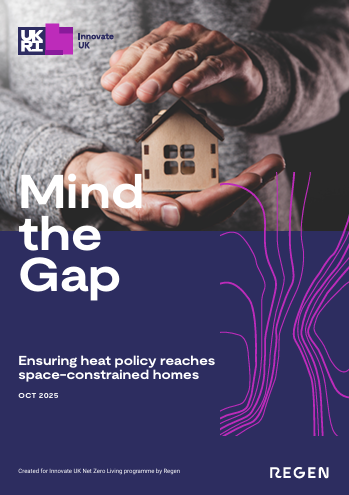
This report shines a light on an estimated 1.8 million properties that are at risk of falling into the ‘heat gap’ between individual heat pumps and a large-scale heat network.
These homes are typically terraced properties or flats with little or no external space that make individual air source heat pumps impractical. At the same time, they may be located in an area that isn’t commercially viable for a heat network. As a result, they fall between the two dominant heat decarbonisation policies, with no clear low-carbon pathway available.
Many heat gap homes risk being stranded on high-carbon, increasingly expensive heating systems, which is especially concerning because space-constrained homes are often found in communities with higher levels of deprivation and fuel poverty. These residents face rising bills and deepening inequalities.
The report offers three clear steps forward. It supports the development of a national methodology to define, map, and quantify these heat gap homes which would help councils develop local heat strategies that ensure no communities are left out.
The report also advocates for the funding of large-scale pilots to help develop scalable, repeatable models. It uses a number of real-world case studies to show that the technologies already exist to serve space-constrained homes. If paired with effective delivery models and strong resident engagement, they could provide low-carbon heat where individual heat pumps are not possible.
Lastly, the report identifies several near-term policy levers that could help close the heat gap today. These include broadening eligibility for grants so more residents can benefit from them, reforming levies to reduce electricity bills, and revising regulations around communal heating projects.
The report shows that the heat gap is a critical piece of the just-transition puzzle. By addressing it, national and local governments can accelerate progress, reduce fuel poverty, and ensure the shift to low-carbon heat genuinely reaches every home.
Released under open government licence
Designed to aid Local Authorities in developing robust, evidence-based plans to enable Net Zero.
Already have an account? Login
 Guest preview of selected publicly available resourcesFull library of 1,000+ articlesCPD accredited e-learning coursesCase studiesDiscussion forum