
This model provides heat pump owners with discounts on their energy bills through investing in a cooperative.
Resource
This model provides heat pump owners with discounts on their energy bills through investing in a cooperative.
Experience Level:
Smart Client
Provided by: Energy Systems Catapult


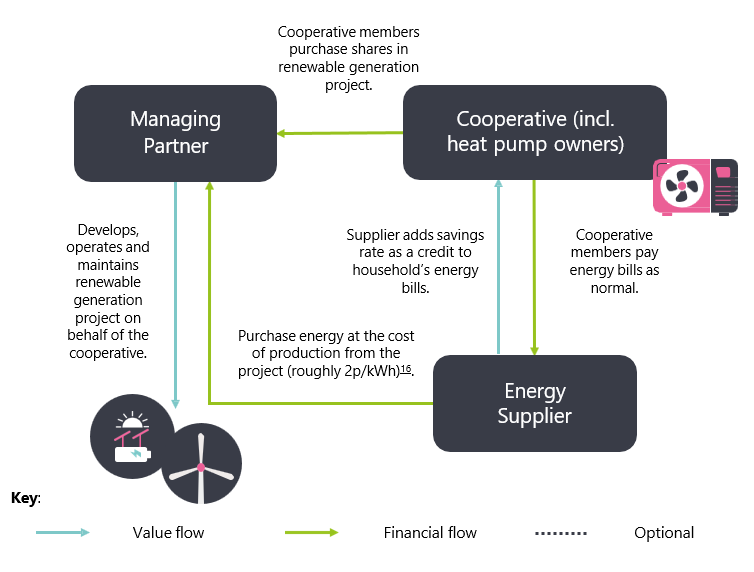
Households can invest in shares of a cooperative society that collectively owns a renewable generation project (e.g. wind or solar farm). The funds raised are used to develop the project, with development, operations and maintenance works undertaken by a managing partner.
Once the project is operational, an energy supply partner purchases renewable electricity generated by the project at its production cost.
The difference between the production cost and the wholesale market price represents the savings rate, which is passed on to cooperative members as a credit on their energy bills for the lifetime of the project or as a dividend payment.
The total savings for each member is calculated by multiplying the savings rate (p/kWh) by their share of energy generated by the renewable assets (kWh).


Ripple. (2024). Graig Fatha monthly blog updates.
Graig Fatha, the UK’s first consumer-owned wind farm, was delivered by Ripple, a renewable energy developer.
The farm has been operational since March 2022 and is owned by over 900 cooperative members.
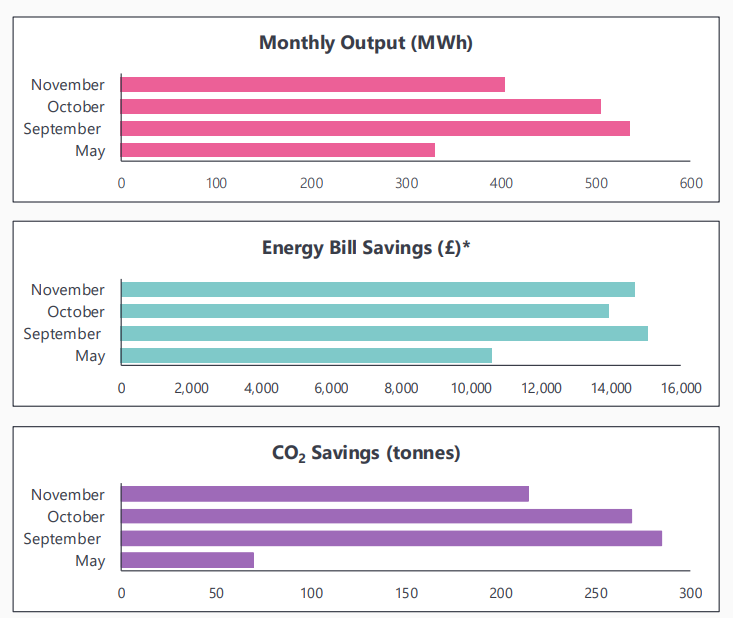
Ripple publishes monthly blog updates that provide key information about the farm’s performance, including metrics such as output, energy bill savings and CO2 emission reductions. The graphs illustrate the farm’s performance using data available for select months in 2024.
The project was supported by a £1.1 million grant from the Welsh Government.
Income generated by the Welsh Government’s portion of ownership is distributed to two charities: the Fuel Bank Foundation and the RCT Interlink. So far, more than £700,000 has been raised and distributed to these charities.
ESC is making this report available under the following conditions. This is intended to make the Information contained in this report available on a similar basis as under the Open Government Licence, but it is not Crown Copyright: it is owned by ESC. Under such licence, ESC is able to make the Information available under the terms of this licence. You are encouraged to Use and re-Use the Information that is available under this ESC licence freely and flexibly, with only a few conditions. Using information under this ESC licence Use by You of the Information indicates your acceptance of the terms and conditions below. ESC grants You a licence to Use the Information subject to the conditions below. You are free to:
You must, where You do any of the above:
These are important conditions of this licence and if You fail to comply with them the rights granted to You under this licence, or any similar licence granted by ESC, will end automatically.
Designed to aid Local Authorities in developing robust, evidence-based plans to enable Net Zero.
Already have an account? Login
 Guest preview of selected publicly available resourcesFull library of 1,000+ articlesCPD accredited e-learning coursesCase studiesDiscussion forum