Business model: Heat pump flexibility - Net Zero Go
Resource

Business model: Heat pump flexibility

Heat pump owners are incentivised to shift their energy usage in line with flexibility events.

Experience Level:

Smart Client
Business model

This resource is part of a collection

Print Email Share URL LinkedIn

Business model: Heat pump flexibility

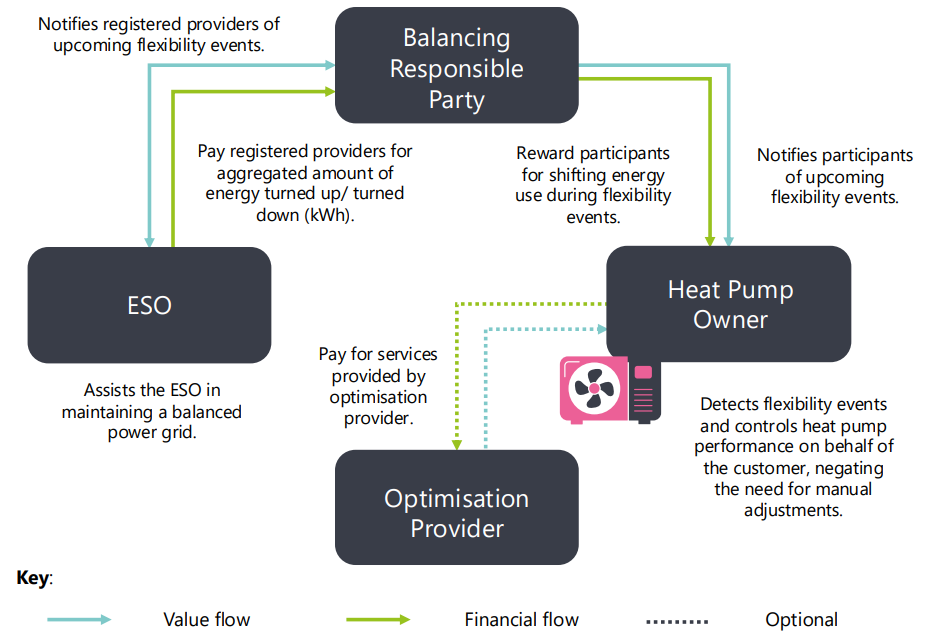
Under this model, heat pump owners are incentivised to shift their energy usage in line with flexibility events.

The Electricity System Operator (ESO) informs registered providers (e.g., energy suppliers) of upcoming flexibility events and pays them for the flexibility they provide to the power system.

Registered providers are responsible for informing participants (e.g., heat pump owners) of flexibility events and reward them if they shift their energy usage during these periods. Rewards may be money, points or prize-based.

Heat pump owners may use an optimisation provider to control heat pump performance during flexibility events on their behalf (at cost).

Primary benefits

  • Consumers are incentivised for participating in flexibility events.
  • Participation is voluntary, meaning households are not penalised if they do not participate in select events.
  • Increases consumers’ awareness of energy usage patterns and may encourage other energy efficiency improvements.
  • Generates system wide benefits such as reduction in grid balancing costs and decrease in demand for fossil fuel-based electricity generation *.
  • If using the services of an optimisation provider, heat pump performance is optimised on behalf of consumers, reducing the need for manual control.

*National Grid. (2023). Second EQUINOX trial launches as first trial shows customers can use heat pump flexibility to save money and reduce network demand.

Key risks and considerations

  • Domestic flexibility services are still being trialed, meaning the proposition is not yet commercially available.
  • At the time of writing, trials have only run during winter months, meaning that customers can currently only benefit at certain time periods. However, the ESO is exploring the possibility of transforming domestic flexibility into a commercial service, available year-round*.
  • Proposition only available to households with smart meters.
  • Unless using an optimisation provider, customers will have to manually control heat pump performance in line with flexibility events.
  • Does not reduce capital cost of heat pump installation, meaning proposition is primarily targeted at able to pay market.
  • Consumers may need to achieve high savings to perceive participation as being worthwhile.

* National Energy System Operator. (2024). ESO sets out initial design for future of Demand Flexibility Service.

    Case study: Equinox flexibility trial

    Overview

    The Equitable Novel Flexibility Exchange (EQUINOX) trial incentivises participants to turn down their heat pumps during peak times of energy demand (either through payments or energy bill reductions). The trial began in December 2022 and is planned to run until December 2025.

    The first stage of the trial ran from December 2022 to April 2023, during which:

    • 386 heat pump owners took part and provided a total turndown of 10.8 MWh.
    • Heat pump owners turned off their heat pumps across 22x two-hour periods (from 5-7pm).
    • The average participation rate across all EQUINOX events was 82%.

    The second stage of the trial ran from 30th October 2023 to April 2024, with the following changes:

    • Double the number of participants.
    • Less regular timings of events — both in terms of intervals between events and timings of events (4-8pm).
    • Notices of future events were issued ‘day ahead’, ‘morning of’ and ‘two-hours before’.
    • Higher payments issued to participants who turned down at shorter notice.
    • Payments based on each kWh of turndown (calculated using historical consumption data).

    ESC is making this report available under the following conditions. This is intended to make the Information contained in this report available on a similar basis as under the Open Government Licence, but it is not Crown Copyright: it is owned by ESC. Under such licence, ESC is able to make the Information available under the terms of this licence. You are encouraged to Use and re-Use the Information that is available under this ESC licence freely and flexibly, with only a few conditions. Using information under this ESC licence Use by You of the Information indicates your acceptance of the terms and conditions below. ESC grants You a licence to Use the Information subject to the conditions below. You are free to:

    • copy, publish, distribute and transmit the Information
    • adapt the Information
    • exploit the Information commercially and non-commercially, for example, by combining it with other information, or by including it in your own product or application.

    You must, where You do any of the above:

    • acknowledge the source of the Information by including the following acknowledgement: “Information taken from Business models and complementary funding mechanisms to support heat pump deployment, by Energy Systems Catapult”
    • provide a copy of or a link to this licence
    • state that the Information contains copyright information licensed under this ESC Licence.
    • acquire and maintain all necessary licences from any third party needed to Use the Information.

    These are important conditions of this licence and if You fail to comply with them the rights granted to You under this licence, or any similar licence granted by ESC, will end automatically.

    Register to access the full article

    Designed to aid Local Authorities in developing robust, evidence-based plans to enable Net Zero.

    Register now

    Already have an account? Login

    Free UK Local Authority access

    Register now
    • Guest preview of selected publicly available resources
    • Full library of 1,000+ articles
    • CPD accredited e-learning courses
    • Case studies
    • Discussion forum