
In Pay as your save (PaYS) business models, some or all of the energy bill savings achieved by retrofitting a home are used to pay back the capital cost of the measures.
Resource
In Pay as your save (PaYS) business models, some or all of the energy bill savings achieved by retrofitting a home are used to pay back the capital cost of the measures.
Experience Level:
Smart Client
Provided by: Energy Systems Catapult


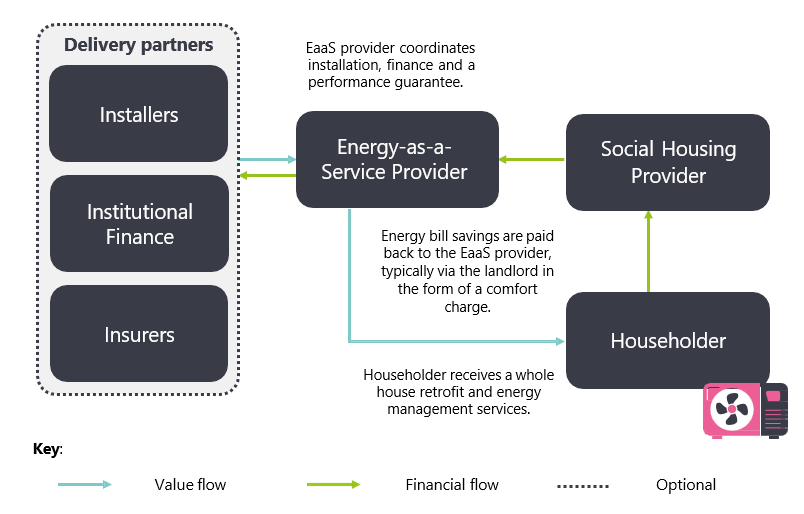
This means the household does not have to pay the costs upfront or see an increase in their total monthly energy payments.
PaYS models may require an EaaS contract, in which the household’s energy consumption is managed and optimised to guarantee predictable monthly payments.
These models are often used to finance whole-house retrofit, where high capital costs are a significant barrier, and particularly in social housing, due to the long duration of the contracts.


Energie Sprong UK. (2024). What is the Energiesprong approach?
The Energiesprong programme was launched in the Netherlands by the Dutch government in 2010, to decarbonise homes. It is an outcomes-based approach that aims to enable home retrofit at scale by allowing the capital cost to be repaid through energy bill savings.
The model requires extensive whole house retrofit to achieve Net Zero energy homes, and a long-term performance guarantee.
Energiesprong implements a package of retrofit and renewable energy measures, including heat pumps, that can be installed within a week. The whole house approach saves on additional costs and disruption that would be incurred by taking a more piecemeal approach.
The household may see a reduction in their total energy bill, or at least pays the same each month for a more comfortable home.
Payback times are typically 30 years.
The Energiesprong approach was pioneered in the UK with Nottingham City Homes, where 60 homes have been transformed to date.
Energiesprong has partnerships across Europe and more recently in the US, with over 5,000 home retrofits completed in the Netherlands, 11,000 total in Europe and almost 500 in the UK. A further 16,000 homes are currently in the pipeline, including 1,500 in the UK.
ESC is making this report available under the following conditions. This is intended to make the Information contained in this report available on a similar basis as under the Open Government Licence, but it is not Crown Copyright: it is owned by ESC. Under such licence, ESC is able to make the Information available under the terms of this licence. You are encouraged to Use and re-Use the Information that is available under this ESC licence freely and flexibly, with only a few conditions. Using information under this ESC licence Use by You of the Information indicates your acceptance of the terms and conditions below. ESC grants You a licence to Use the Information subject to the conditions below. You are free to:
You must, where You do any of the above:
These are important conditions of this licence and if You fail to comply with them the rights granted to You under this licence, or any similar licence granted by ESC, will end automatically.
Designed to aid Local Authorities in developing robust, evidence-based plans to enable Net Zero.
Already have an account? Login
 Guest preview of selected publicly available resourcesFull library of 1,000+ articlesCPD accredited e-learning coursesCase studiesDiscussion forum