
The Green Finance Institute’s Coalition for the Decarbonisation of Road Transport has created this guide to provide investors with information on the battery supply chain to unlock the investment the UK needs to capture this opportunity.
Resource
The Green Finance Institute’s Coalition for the Decarbonisation of Road Transport has created this guide to provide investors with information on the battery supply chain to unlock the investment the UK needs to capture this opportunity.


The electric vehicle (EV) transition has potential to grow the automotive battery market to £12 billion in the UK as early as 2025. Growing battery supply chain capacity presents a significant opportunity for a wide range of investors, both those familiar with, and those new to the sector. The Green Finance Institute’s Coalition for the Decarbonisation of Road Transport has created this guide to provide investors with information on the battery supply chain to unlock the investment the UK needs to capture this opportunity.
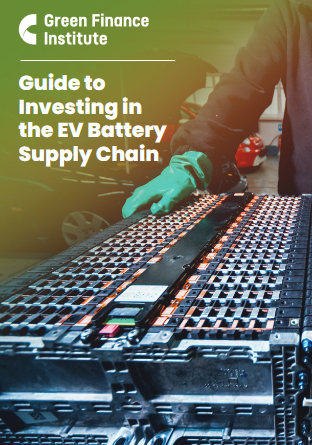 Batteries are a key enabling technology in the decarbonisation of numerous sectors, including transport, and will be needed for most light passenger vehicles, vans, and some heavy goods vehicles. Demand for batteries in multiple sectors, including automotive, is creating a significant growth opportunity for companies scaling capabilities across the battery supply chain, requiring significant pools of capital from investors across the financial spectrum, new and existing. The UK has a window of opportunity to play a key role in the transition and grow its current battery manufacturing pipeline. Increasing investor understanding of the sector quickly is critical to seize this opportunity.
Upstream: Demand for key raw materials needed to manufacture automotive batteries is expected to grow by as much as 500% by 2040. Obtaining supply of these materials is a key concern and given the time taken to scale capabilities to extract and process materials, investment is urgently required. Existing extraction capabilities are relatively concentrated in a few countries globally, with China controlling much of the supply due to extensive capabilities in processing and investment in overseas extraction.
Although the UK is unlikely to satisfy the entirety of its raw material demand for batteries from local supply, there are a variety of investment opportunities to grow the UK’s promising pipeline of raw material extraction facilities, which includes companies experimenting with new faster extraction technologies, and expanding pre-existing processing capabilities. Regulation is driving increased transparency across the supply chain and demand for domestic extraction and processing projects from battery manufacturers downstream.
Midstream: Most cells used today for electric vehicles use lithium-ion (Li-ion) technology, referring to the specific chemicals used to manufacture the key components such as the anode and cathode. Investment is needed in both companies innovating in Li-ion technologies, as well as new technologies which use different chemicals. New technologies take time to be proven at scale and are expected to fit into existing production lines. Several investment opportunities exist to help the UK build on its strong heritage in chemicals to increase electrolyte production, and establish anode and cathode facilities, with regulation governing rules of origin driving demand for local producers.
Automakers looking for batteries with strong green credentials will be attracted to UK-based producers able to take advantage of the UK’s green energy mix. Cell manufacturing refers to the process of combining the cell components, typically done in a gigafactory. It is considered the most important step in the battery value chain, expected to account for up to 40% of battery industry value creation by 2030. China currently dominates the production of most cell components, and has 79% of global cell manufacturing, though the US and EU are rapidly growing their pipelines. The UK has one gigafactory (<1% of global capacity) operated by Envision AESC, but more are needed to meet the forecast demand, requiring significant investment.
Downstream: A battery supply chain needs companies able to assemble the battery module and pack using cells acquired from cell manufacturers. These capabilities can be performed by different actors, including automakers, with assembly often occurring in close proximity to vehicle manufacture. Currently, the UK has some assembly capabilities but needs to grow capacity to meet future EV demand.
End of life – second use and recycling: Current EV batteries degrade an average of just 2.3% per year, which means that after use in an EV, they can either be used in another application or recycled. Like many countries, the UK is yet to build battery recycling at industrial scale, primarily due to lack of UK-based battery manufacturers to provide feedstock. However, strong recent EV adoption combined with legislative battery recycling targets is expected to create a steady pipeline of retired EV batteries; a spate of recent announcements indicates this is a growth sector.
Policy: Governments globally continue to commit to electrify transport and meet Net Zero targets, stimulating EV uptake and demand for automotive batteries. Extensive policy support in major markets to attract some of the supply chain speaks to the strategic importance of the sector and its role in energy security; the Inflation Reduction Act (IRA) in the US, and the EU Green Deal have both already stimulated huge amounts of private investment. Though the UK already offers extensive support for the automotive sector, it is yet to respond with a similar broader strategy.
Designed to aid Local Authorities in developing robust, evidence-based plans to enable Net Zero.
Already have an account? Login
 Guest preview of selected publicly available resourcesFull library of 1,000+ articlesCPD accredited e-learning coursesCase studiesDiscussion forum