Guidance for assessing clean energy projects: Supporting planners in delivering the transition
Planning plays a critical role in delivering a clean, secure, and affordable energy system. This guidance, produced by Regen on behalf of DESNZ, supports local authority planners to assess renewable and low-carbon electricity infrastructure projects.
This Regen guidance helps planners assess clean energy projects more consistently and confidently. It sets out clear principles for weighing national Net Zero need against local impacts, with practical questions covering project scale, location, benefits, and community considerations. The guidance is designed to align planning decisions with climate policy while remaining rooted in place-based judgement.
For local authorities, the guidance offers a robust and defensible approach to decision-making. It supports officers and members in handling complex renewable applications, improving consistency, reducing risk at appeal, and helping councils play a proactive role in delivering Net Zero infrastructure.
Guidance for assessing clean energy projects: Supporting planners in delivering the transition
As the UK accelerates towards a clean power and Net Zero future, local authorities are at the frontline of the energy transition. Local planners are seeing a growing volume of complex and technical applications for ground-mounted solar, battery storage, onshore wind, and electricity network infrastructure. These projects are essential for decarbonising the grid, strengthening energy security, and delivering affordable power.
But local planning teams are often stretched, with limited time and capacity to keep up with evolving policy, technical standards, and best practice.
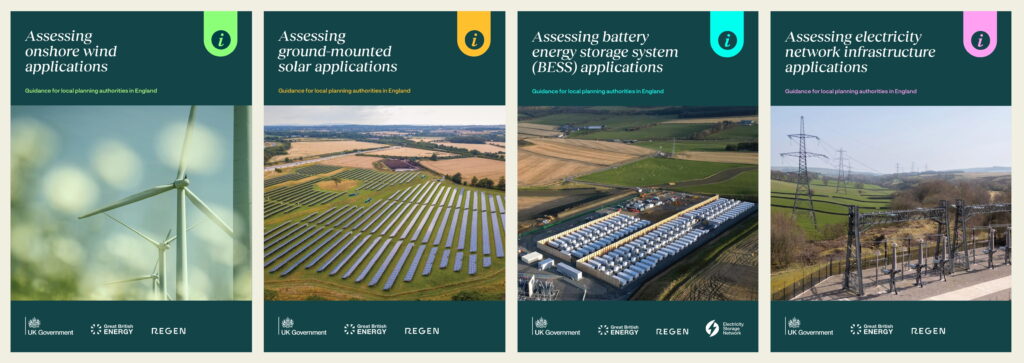
That is why Regen has partnered with the Department for Energy Security and Net Zero (DESNZ), Great British Energy, and the Local Net Zero Hubs to provide planners with new guidance and training to support them in assessing onshore wind, ground-mounted solar, battery storage, and electricity network infrastructure applications.
These guidance documents have been developed with input from industry, planners, and government departments. They provide clear overviews of each technology, including key components and common stages of development, outline relevant planning policy and guidance, highlight common considerations likely to emerge when assessing applications, and signpost other helpful resources.
The four guides cover:
Assessing onshore wind applications
Assessing ground-mounted solar applications
Assessing battery energy storage system (BESS) applications
This guidance will be updated to reflect any policy changes when the revised NPPF is published later in 2026.
Training for planning officers: Planning for clean energy
During February and March 2026, Regen delivered online training sessions for local planning authority officers through the regional Net Zero Hubs.
We shared key information from the guidance and invited developers to share practical insights from real case studies, facilitating discussions with planners on the best ways to navigate planning challenges.
In this introduction, we discuss what to expect from the guidance and explain the UK government’s strategic approach to energy planning and how this is driving an increase in renewable and low-carbon energy developments.
Onshore wind
This video features four presentations from onshore wind developers, who discuss the process of identifying project sites, examples of projects where planning-related challenges were experienced and overcome, and opportunities for developers and planners to improve the planning process.
Key topics include:
Repowering
Changes since the de-facto ban in 2015
Landscape and visual impacts
Shadow flicker
Battery energy storage system (BESS)
This section features two presentations from BESS developers, who discuss the process of identifying project sites, examples of projects where planning-related challenges were experienced and overcome, and opportunities for developers and planners to improve the planning process.
Key topics include:
Operational noise
Fire risk and safety
Site design and changing technology
Ground-mounted solar
This section features two presentations from solar developers, who discuss the process of identifying project sites, examples of projects where planning-related challenges were experienced and overcome, and opportunities for developers and planners to improve the planning process.
Key topics include:
Overplanting
Agricultural land use
Glint and glare and cumulative impacts
Electricity network infrastructure
Here we feature two presentations from distribution network operators, who discuss their process of identifying project sites and planning network upgrades.
Guest preview of selected publicly available resources
Full library of 1,000+ articles
CPD accredited e-learning courses
Case studies
Discussion forum
Manage Consent
To provide the best experiences, we use technologies like cookies to store and/or access device information. Consenting to these technologies will allow us to process data such as browsing behaviour or unique IDs on this site. Not consenting or withdrawing consent, may adversely affect certain features and functions.
Functional
Always active
The technical storage or access is strictly necessary for the legitimate purpose of enabling the use of a specific service explicitly requested by the subscriber or user, or for the sole purpose of carrying out the transmission of a communication over an electronic communications network.
Preferences
The technical storage or access is necessary for the legitimate purpose of storing preferences that are not requested by the subscriber or user.
Statistics
The technical storage or access that is used exclusively for statistical purposes.The technical storage or access that is used exclusively for anonymous statistical purposes. Without a subpoena, voluntary compliance on the part of your Internet Service Provider, or additional records from a third party, information stored or retrieved for this purpose alone cannot usually be used to identify you.
Marketing
The technical storage or access is required to create user profiles to send advertising, or to track the user on a website or across several websites for similar marketing purposes.




 Guest preview of selected publicly available resources