
The Greater London Authority (GLA) created this tool to show how carbon emissions can be reduced to net zero by 2050.
Resource
The Greater London Authority (GLA) created this tool to show how carbon emissions can be reduced to net zero by 2050.


The Mayor of London has set a target for London to be net zero carbon by 2030. To support this ambition, he commissioned experts Element Energy to analyse the possible pathways to achieving net zero.
Fairness must be central in the net zero pathway. The cost of no action will impact lower income Londoners the most, with overheating, toxic air and flooding all posing a risk. We must ensure we’re supporting those on low incomes from the costs. And ensure they benefit from warm, energy efficient homes, cleaner air and the new green jobs that will come from taking faster action.
Element Energy analysed four possible pathways to net zero, looking at the different ways London can reduce emissions. The report shows that, under all pathways, it is possible to speed up action and radically reduce carbon emissions with the right ambition, leadership, powers and funding.
As well as helping avoid catastrophic climate change, there are many other benefits in achieving net zero, including:
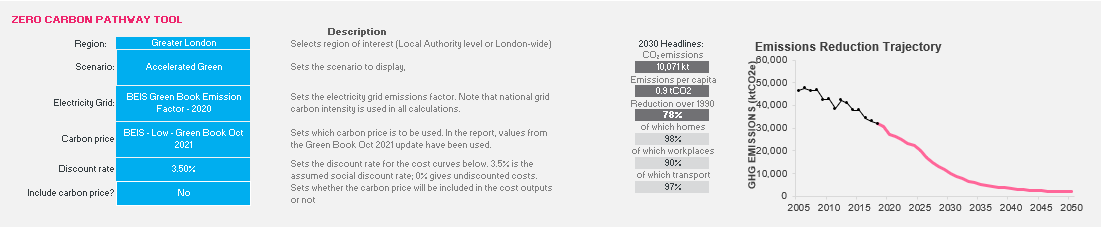
London’s Zero Carbon Pathways Tool shows four ways that carbon emissions might be reduced to net zero by 2030.
The Tool, developed by Element Energy, accompanies the report “Analysis of a Net Zero 2030 Target for Greater London” also written by Element Energy. This report should be read in conjunction with the tool for an explanation of the assumptions behind the four pathways.
In the Tool, energy and carbon results are presented by sector, as well as some sector specific results such as vehicle kilometres for transport and supply by fuel type for district heat. Modelling has been done on a pan-London basis, so borough level results are an estimate only.
This Zero Carbon Pathways Tool is an update of an earlier tool published in 2018, which showed pathways to net zero emissions by 2050. This older tool can also be found below.
Designed to aid Local Authorities in developing robust, evidence-based plans to enable Net Zero.
Already have an account? Login
 Guest preview of selected publicly available resourcesFull library of 1,000+ articlesCPD accredited e-learning coursesCase studiesDiscussion forum