Energy Systems Catapult has published guidance on how to create a Local Area Energy Plan (LAEP), aimed at local government organisations who are looking to create a plan to help them meet their net zero goals and climate emergency declarations.
A LAEP sets out the change required to transition an area’s energy system to Net Zero in a given timeframe. This is achieved by exploring potential pathways that consider a range of technologies and scenarios, and when combined with stakeholder engagement leads to the identification of the most cost-effective preferred pathway and a sequenced plan of proposed actions to achieving an area’s Net Zero goal.
The Guidance provides a detailed description of the end-to-end process of creating a LAEP, broken down into seven stages:
- Stage 1 – Preparation
- Stage 2 – Stakeholder Identification and Engagement
- Stage 3 – Understanding and Representing the Current Local Energy System
- Stage 4 – Modelling Options for the Future
- Stage 5 – Scenario Refinement and Selection
- Stage 6 – Actions, Priorities, and Decisions
- Stage 7 – Create the Plan
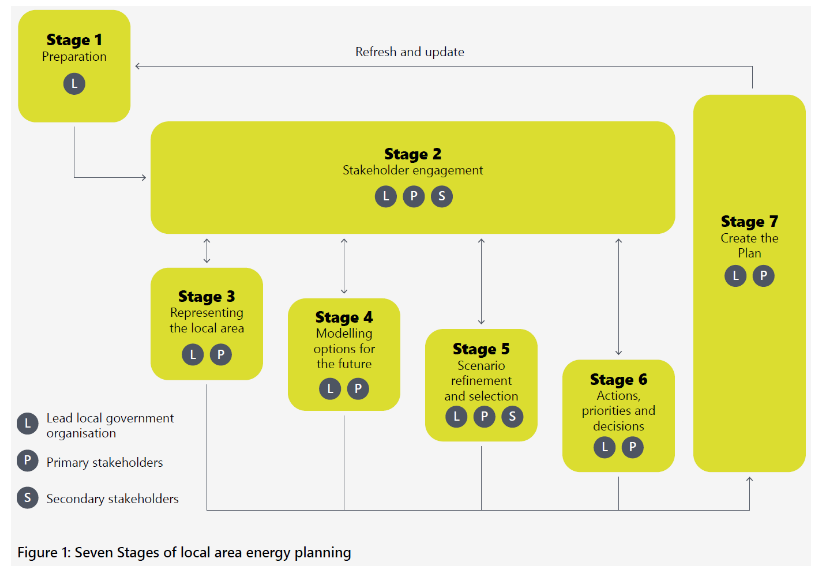
Each stage is broken down into several steps, with each step having specific objectives. Each objective describes specific tasks, how they can be tackled, what considerations need to be made when tackling them, and links to any supporting sources.
Why has this Guidance been developed?
This Guidance has been developed to meet the need for a common approach to LAEP.
A previous study by Energy Systems Catapult identified that LAEP guidance and templates are needed. Without them, local authorities and other stakeholders do not know what they are producing, how they should do it, and what they should include. Guidance, with accompanying suggested approaches and templates, will enable production of LAEPs in a standardised and consistent way.
This Guidance serves several purposes, including:
- A common approach allows for comparability between areas, and for multiple plans to be aggregated across a large area (i.e., a region).
- A common approach delivers efficiencies and value for money through familiarity for organisations involved in delivering several LAEPs, or for an organisation renewing a LAEP.
- A common approach identifies the characteristics of the underlying data and assumptions involved in creating a LAEP.
- To identify and provide clear guidance on the roles and responsibilities of those involved in creating a LAEP.
- To identify key characteristics of a minimum standard for creating a LAEP, that are consistent across multiple LAEPs.
- To provide confidence to those funding the implementation of the LAEP.
- To ensure that modelling tools meet the requirements to create a LAEP.
Energy Systems Catapult was commissioned by UK Research and Innovation (UKRI) to create the Guidance.
Who is the Guidance for?
The Guidance is written for multiple audiences:
- Primarily, it is written for local government organisations who are anticipated will lead creating local area energy plans.
- Secondly, it is written for key stakeholders who have an active role contributing and supporting a local government organisation as it creates a LAEP. This includes network operators, and consultants contracted to deliver aspects of a LAEP on behalf of a local authority.
- It is also written for other stakeholders who have a role in supporting a local authority as it creates a LAEP. This includes the general public and community groups, Local Enterprise Partnership (LEP), Net Zero Hub, academics, industry, social housing provides, investors and businesses in the locality where a LAEP is being developed.
- It is also written for other organisations who have an interest in net zero, including government departments (such as BEIS, DfT, DLUHC), devolved administrations, and national organisations (such as Ofgem, National Grid).



 Guest preview of selected publicly available resources