Business Model: Utility PPA - Net Zero Go
Resource

Business Model: Utility PPA

A utility PPA is a bilateral agreement between a generator (asset owner) and an energy supplier (or other balancing responsible party).
Business model

This resource is part of a collection

Print Email Share URL LinkedIn

A utility Power purchase agreement (PPA) is a bilateral agreement between a generator (asset owner) and an energy supplier (or other balancing responsible party). It is sometimes referred to as a ‘Merchant PPA’ or ‘Export PPA’.
 

This model could be enacted by local authorities as follows:

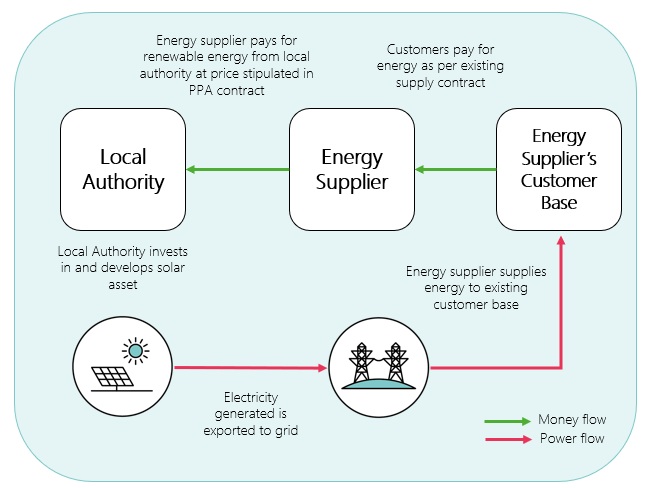
  • Local authority designs, builds and commissions solar generation asset.
  • Renewable energy generated by the solar asset is purchased by an energy supplier at an agreed upon volume and price (as stipulated in the PPA contract).
  • Electricity generated is exported to the power grid.
  • Energy supplier continues to facilitate the supply of energy to their existing customer base as usual.
  • There are a couple of arrangements for merchant PPAs; Fixed and flexible.
image.png

Merchant PPA: Fixed PPA

Fixed PPA with licensed supplier / balancing party

The generator is paid a set p/kWh for all generationover a fixed term. The price may be flat tariff or time-of-day/season tariff.

The pass through of any embedded benefits or costs will be detailed in the PPA and should be reviewed.

Duration

  • Suppliers typically offer a fixed price PPA for up to 4 years.
  • At the end of this period the generator will need to enter a new PPA arrangement.
  • Longer term PPAs are possible (up to 15 years) however they tend to provide lower prices, or the price is only fixed for the first couple of years and then tracks the wholesale price

Providers

  • Several licensed suppliers offer fixed price PPAs.
  • Generators can approach suppliers directly for quotes or via a third party (e.g., a framework or agent). PPAs can also be obtained via auction (e.g. E-power) where suppliers bid for renewable generation contracts
  • Some suppliers will only fix the PPA terms shortly before the contract start date, whereas others are happy to fix further in advance.

Complexity

  • Fixed PPAs are straight-forward to obtain, but the ability to dictate terms is severely limited.
  • Contract terms are fairly standard and generic but should be reviewed by the generator’s legal team.

Price certainty

  • Provides short-term price certainty.
  • Datasets are available from specialist organisations that forecast energy prices into the future, however there is no certainty of power price outside of the duration of the PPA term.

Merchant PPA: Flexible PPA

Flexible PPA with licensed supplier / balancing party

  • Similar to the fixed PPA, but the price paid to the generator tracks the wholesale electricity price, either on a seasonal, monthly or daily basis or in real time – exposing the project to different levels of power price volatility.
  • The pass through of any embedded benefits or costs will be detailed in the PPA and should be reviewed.

Duration

  • Suppliers typically offer a flexible price PPA for up to ~5 years.
  • At the end of this period the generator will need to enter a new PPA arrangement.
  • A flexible price might be part of a longer-term PPA where the price is fixed for the first couple of years.

Providers

  • Several licensed suppliers offer flexible price PPAs.
  • Generators can approach suppliers directly for quotes or via a third party (e.g., a framework or agent).

Complexity

  • As per Fixed PPAs, Flexible PPAs are straight-forward to obtain, but the ability to dictate terms is severely limited. Contract terms are fairly standard and generic but should be reviewed by the generator’s legal team.

Price certainty

  • Some PPAs include a “price floor” and a “price ceiling”.
  • Flexible PPAs are wholesale market dependent, so hold greater financial uncertainty than a fixed price PPA on a short-term basis and can even result in negative pricing if positive price floors are not included.
  • Datasets are available from specialist organisations that forecast energy prices into the future.

ESC is making this report available under the following conditions. This is intended to make the Information contained in this report available on a similar basis as under the Open Government Licence, but it is not Crown Copyright: it is owned by ESC. Under such licence, ESC is able to make the Information available under the terms of this licence. You are encouraged to Use and re-Use the Information that is available under this ESC licence freely and flexibly, with only a few conditions. Using information under this ESC licence Use by You of the Information indicates your acceptance of the terms and conditions below. ESC grants You a licence to Use the Information subject to the conditions below. You are free to:

  • copy, publish, distribute and transmit the Information
  • adapt the Information
  • exploit the Information commercially and non-commercially, for example, by combining it with other information, or by including it in your own product or application.

You must, where You do any of the above:

  • acknowledge the source of the Information by including the following acknowledgement: “Information taken from Business models and complementary funding mechanisms to support heat pump deployment, by Energy Systems Catapult”
  • provide a copy of or a link to this licence
  • state that the Information contains copyright information licensed under this ESC Licence.
  • acquire and maintain all necessary licences from any third party needed to Use the Information.

These are important conditions of this licence and if You fail to comply with them the rights granted to You under this licence, or any similar licence granted by ESC, will end automatically.

Register to access the full article

Designed to aid Local Authorities in developing robust, evidence-based plans to enable Net Zero.

Register now

Already have an account? Login

Free UK Local Authority access

Register now
  • Guest preview of selected publicly available resources
  • Full library of 1,000+ articles
  • CPD accredited e-learning courses
  • Case studies
  • Discussion forum