Business Model: Private Wire - Net Zero Go
Resource

Business Model: Private Wire

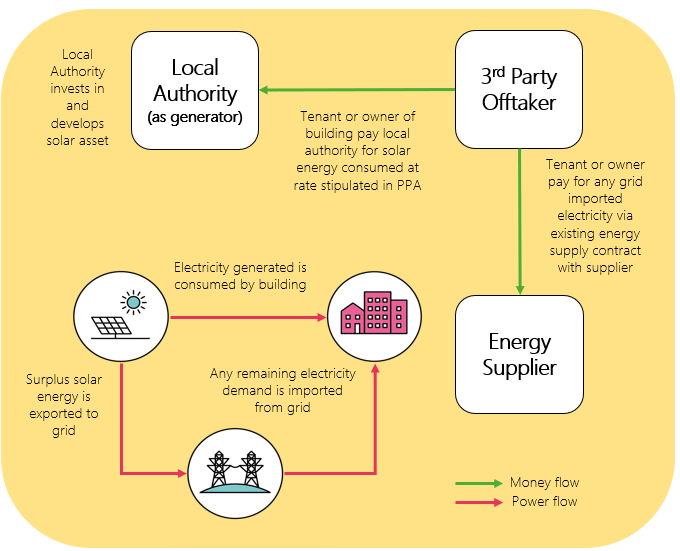
In the private wire business model, a solar asset is directly connected to the point of offtake and electricity generated is used to satisfy site demand
Business model

This resource is part of a collection

Print Email Share URL LinkedIn
In the private wire business model, a solar asset is directly connected to the point of offtake and electricity generated is used to satisfy site demand. Surplus solar generation is exported to the power grid.
A private wire is sometimes referred to as a ‘Behind the Meter (BtM) PPA This model can be enacted by local authorities as follows:
  • Local authority designsbuilds and commissions solar generation asset on/ near building.
  • Capital and operating costs are recovered through a PPA with a third-party offtaker (most likely a tenant in a local authority owned building but this does not always have to be the case).
  • The third-party offtaker pays for any grid imported electricity through their existing supply contract.
  • The local authority may generate additional revenue from surplus solar export.
  • This will require an additional export arrangement with a balancing responsible party.
image.png
image.png
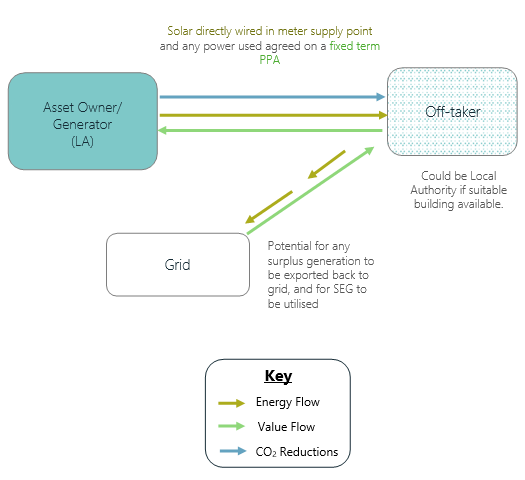
  • A private wire is where a generator connects directly to a building or site, replacing any power they would have imported
  • A private wire is not subject to the same regulation and charges (e.g. use of system or policy charges) that standard exported electricity would face
  • This is highly valuable for both parties depending on the cost of setting up the private wire:
    • For the off-taker, they will have to import electricity as normal when there is not any power available from the private wire
    • For the generator, anytime there is not sufficient demand from the off-taker, the excess power will be exported onto the grid which requires separate commercial

Key Benefits

Financial and CO2

  • Decrease in energy bills for off- taker
  • Uplift in price for generator
  • Reduces carbon emissions for off- taker through reduced import from grid

Other Benefits

  • Long-term price security for generator and off-taker
  • Local skills and jobs
  • Can be expanded with additional capacity at good site locations

Risks and Considerations

  • Complex to deliver
  • Requires suitable locations and demand close to generator
  • “Optimism bias” – can suffer from poor initial cost estimates and spiralling costs
  • Value from avoided system and policy costs likely to be removed in future
  • Very difficult to find sites of sufficient size next to an off- taker
  • Cost of setting up the private wire

Suitable for

  • Technology – primarily solar, storage could be included in future
  • Schemes with a large baseload which is guaranteed over time
  • Sufficient network and grid connection capacity, so that the off- taker does not incur any upgrade costs
  • Suitable land needs to be available in the area, where generation can be placed close to demand and create limited issues in terms of planning consent for the private wire

Contracts Required

  • Direct PPA – if the generator and off-taker are different parties
  • Contract with Electricity Supplier – off-taker contracts with electricity supplier for balance of electricity
  • DNO – Grid Connection Offer and agreement to be in place
  • Construction & Legal – construction contract for generation, installation and for “Private Wire”. Legal contracts to fulfil third party land rights and H&S
  • Operational – Operational contracts for running and maintenance of “Private Wire”

Contractual Considerations

  • Specifying the requirements for the private wire is a specialist skill and will require a proper engineering review of the proposed route to identify additional challenges
  • It is likely that the generator would be an exempt supplier under the Supply Licence Exemption Rules – but specialist advice on this should be sought by the project
  • Connection arrangements can become complex as the generator will generally not be allowed to connect to the grid other than at the off- taker’s site
image.png

ESC is making this report available under the following conditions. This is intended to make the Information contained in this report available on a similar basis as under the Open Government Licence, but it is not Crown Copyright: it is owned by ESC. Under such licence, ESC is able to make the Information available under the terms of this licence. You are encouraged to Use and re-Use the Information that is available under this ESC licence freely and flexibly, with only a few conditions. Using information under this ESC licence Use by You of the Information indicates your acceptance of the terms and conditions below. ESC grants You a licence to Use the Information subject to the conditions below. You are free to:

  • copy, publish, distribute and transmit the Information
  • adapt the Information
  • exploit the Information commercially and non-commercially, for example, by combining it with other information, or by including it in your own product or application.

You must, where You do any of the above:

  • acknowledge the source of the Information by including the following acknowledgement: “Information taken from Business models and complementary funding mechanisms to support heat pump deployment, by Energy Systems Catapult”
  • provide a copy of or a link to this licence
  • state that the Information contains copyright information licensed under this ESC Licence.
  • acquire and maintain all necessary licences from any third party needed to Use the Information.

These are important conditions of this licence and if You fail to comply with them the rights granted to You under this licence, or any similar licence granted by ESC, will end automatically.

Register to access the full article

Designed to aid Local Authorities in developing robust, evidence-based plans to enable Net Zero.

Register now

Already have an account? Login

Free UK Local Authority access

Register now
  • Guest preview of selected publicly available resources
  • Full library of 1,000+ articles
  • CPD accredited e-learning courses
  • Case studies
  • Discussion forum