
Private sector company responsible for design, financing, building, owning and operation.
Resource
Private sector company responsible for design, financing, building, owning and operation.

Provided by: Department for Energy Security and Net Zero (DESNZ)


Private sector company responsible for design, financing, building, owning and operation. The roles that define a project as private sector led are likely to be Funding, Asset Ownership and Operation
Key roles for Private Sector LedThe key roles that may determine a scheme as being “private sector led” are the fact that some funding is provided by the private sector, matched with ownership of assets, as well as responsibility for operation of the scheme (albeit not all roles will necessarily lie with the same private sector party). Private sector led schemes often arise on private developments as a consequence of compliance with planning policy and incorporated into a planning obligation (i.e. as part of a section 106 agreement) to construct a heat network on the site. |
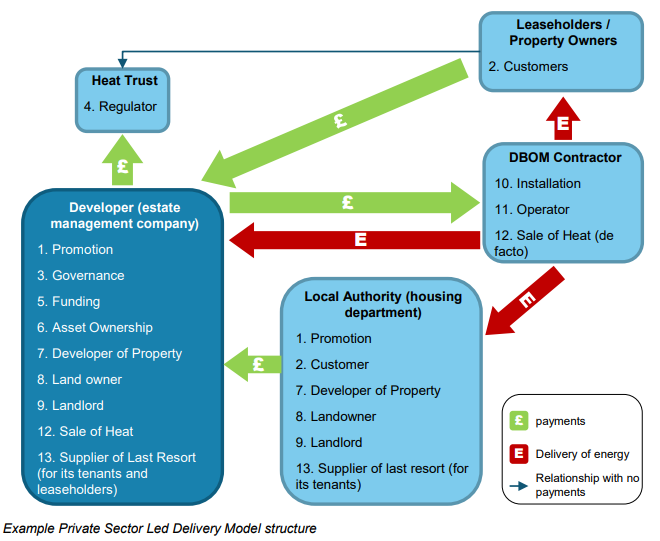 |
On such schemes a concession may be granted to a third party provider who will substantially fund, design, construct, install, operate and maintain a network across the development. A ‘concession agreement’ would grant a company or consortia exclusivity to provide heat on a given site for a period of typically 25 years or more.
Such schemes are typically on development sites with one master developer or one single developer. A network procured as a single concession serving multiple developers’ sites is conceivable, but such an approach will be complex and difficult to negotiate and may also require a degree of fortune in the timing of the respective independent development sites (the exception to this is being trialled Vauxhall Nine Elms).
The developer, or more often the appointed concession contractor, may elect to extend the network to serve customers beyond the boundaries of the original development which initiated the network. However the terms of the concession contract that bind parties (the developer and the Private Sector Company) within this development are unlikely to be enforceable beyond it.
In seeking to reduce costs for its customers (tenants or purchasers of property for example), a private Developer of Property may decide to part fund the scheme and/or own the assets for a rate of return at a lower margin.
The private sector delivery model is attractive to Local Authorities who are risk averse and do not have the capability or appetite to undertake any of the key delivery roles associated with a heat network scheme. With Private Sector Led delivery models, the only roles undertaken by a Local Authority are likely to be Promotion and potentially Development of Property and Customer.
A developer procuring a heat network will need to consider the contractual framework that it puts in place (for example, whether it wishes to procure services in distinct bundles. These bundles could be design and build (D&B), operate and maintain (O&M) and Metering and Supply.
Alternatively the procurer may wish to aggregate the provision of services. This may provide a more easily managed suite of contracts, however reduces the flexibility and potential price savings driven from competition (e.g. by re -procuring a services or O&M contract on a rolling basis).
The key tax issues to consider in a private sector led project include:
The advantages and disadvantages of different models are actually determined by the considering the advantages and disadvantages of taking on particular roles.
Having said that, if a project falls into the Private Sector model type it can have the advantage of allowing private sector expertise to be adequately remunerated for management and mitigation of risk.
The disadvantage of this is that higher returns are expected on investments, which may mean additional costs for developers. It should be noted that it should not mean additional costs for customers, particularly domestic customers, as prices should be based on a comparator rather than a cost plus basis
|
1. Promotion |
Developer / Local Authority / Landowner |
|
2. Customer |
Customer / Landlord |
|
3. Governance |
Private ESCo / Contractor via contract with Promoter |
|
4. Regulation |
Private ESCo / Contractor via contract with Promoter |
|
5. Funding |
Private ESCo/ Developer / Local Authority |
|
6. Asset Ownership |
Private ESCo/ Developer / Landlord |
|
7. Development of Property |
Developer (may include Local Authority) |
|
8. Land Ownership |
Land Owner(s) |
|
9. Landlordship |
Landlord(s) / ManCo |
|
10. Installation |
Private ESCo or Contractor |
|
11. Operation |
Private ESCo |
|
12. Sale of Heat |
Private ESCo / ManCo |
|
13. Supplier of Last Resort |
ManCo / Landlord |
Designed to aid Local Authorities in developing robust, evidence-based plans to enable Net Zero.
Already have an account? Login
 Guest preview of selected publicly available resourcesFull library of 1,000+ articlesCPD accredited e-learning coursesCase studiesDiscussion forum